


DREADNOUGHTS Delivers an Uncomfortably Close Dystopia from MIKE CARROLL and JOHN HIGGINS
- Andrew Irvin

- Dec 10, 2025
- 17 min read
With the deep perversion of justice underway across the United States, currently governed by those actively misappropriating the image of Judge Dredd, it is an opportune moment to sit down with two masters of the craft; Mike Carroll and John Higgins, here to discuss the return of Dreadnoughts to the pages of 2000 AD.
COMIC BOOK YETI: John and Mike, welcome to the Yeti Cave! It is an honor to have you both stop by today to discuss Dreadnoughts. How are things going back in the UK at the moment? What sort of plans do you both have in store for the end of the year?
MIKE CARROLL: I can’t really comment on the state of things in the UK but here in the People’s Glorious Republic of Ireland (which is an entirely separate country, albeit next door) things are pretty much business as usual: weather, taxes, Christmas ads in November, the vocal ignorant being furious at the wrong people about imaginary misgivings… Oh, and we have a brand-new president after fourteen years, which is interesting. The previous one was rather awesome so Catherine Connolly has a lot to live up to, but I sure she’ll do a great job.
JOHN HIGGINS: The UK at the moment? The sun is shining on a cold December day, I walked to the beach and watched the waves crash onto the beach. Having just finished the last episode of the new Dreadnoughts, life is good.
CBY: I'm glad to hear operating on either side of the EU divide isn't slowing either of you down one bit. What is the general concept of Dreadnoughts? For readers who haven’t read it before, what is the series about, and how did it first come together?
MC: Dreadnoughts is a precursor to the world of Judge Dredd, in which the lawmakers have become the ultimate power in the USA, answerable to no one but themselves. In the earliest stories (published in the late 1970s, but set in 2099) Dredd and the other Judges were presented as heroes, the only sane response to a crazy world, but over time Dredd’s co-creator John Wagner solidified the idea that the Judges are basically fascists. They might not see themselves like that, but when you’ve taken all the power from the people then you no longer have a democracy.

Some elements of the history of Dredd’s world – basically how the USA turned into Mega-City One – were occasionally mentioned over the years, but generally only in very broad strokes. Back around 2017 we decided that it might be interesting to explore that in more detail, so we came up with the Judges series of prose novellas. Three trilogies, so far; the first set in the 2030s, then the 2040s, and the 2050s. If the series continues, we’ll hopefully tackle the 2060s – the most intense era in Dredd’s history: world-wide atomic war as well as civil war in the USA – and then wrap up with the 2070s, which will lead neatly into the already-established Judge Dredd Year One novellas which depict Dredd’s first year as a Judge on the streets of Mega-City One.
The Dreadnoughts series is a comic-strip spin-off from the Judges books, and we deliberately decided to stick with the 2030s when the first Judges are on the streets alongside the ordinary cops, most of whom can very clearly see that their days are numbered.
JH: Mike has it right. Tick!
CBY: Thank you for the truncated timeline of the world of Judge Dredd, which should prove quite useful for the uninitiated. There’s a story at the end of Book One, set in 2033, from which I quote, “The single most important right any American citizen has is due process. The right to unbiased judgement when accused. You Judges have taken that right and flushed it down the crapper.” Did you have any idea your story would become so relevant as we see what’s going on in the real world?
MC: There was never a deliberate intention to shine a light onto the real world. For Judges and Dreadnoughts to work I had to plot a path from where we were back in 2017 (when the first Judges novella, The Avalanche, was written) to the fascistic Mega-City One of 2099, and that meant conjuring up the worst things that might happen. The loss of the right to due process was the scariest thing I could think of.
The idea that ordinary people could be snatched off the streets or dragged out of their homes by faceless, merciless, agents of the law, imprisoned without trial, without appeal, without even an accusation being made against them… that’s surely the stuff of nightmares and it could never happen in the real world. Certainly not in a nation that for decades has been beating its chest as it screams about how great it is to have “freedom.”
CBY: Yeah, the rapidity of the decline in rule of law Stateside should be an alarming bellwether for societies around the world where citizens may want to shore up their rights through antifascist countermeasures at a community level. Broadly in Judge Dredd stories, Mega City One represents a fully-fledged dystopia operating generations into the future. Dreadnoughts reels us back to a world within a generation of now, and the distance between our current governance paradigm and a fully entrenched Judge system is depicted as much smaller than many people might be comfortable recognizing. With Book One dropping in 2021, produced having witnessed the chaos of the 45th US presidential administration, and Book Two released shortly before inauguration of the 47th US administration, the world has veered even more sharply toward a debilitatingly dysfunctional techno-dystopia. What additional events have informed this current run of Dreadnoughts, and how do you keep your fiction – staged in this narrative space much closer to our own time – comprehensively responsive to the rapidly shifting landscape of international law and order?
MC: I do my best to keep up with international events, but Dreadnoughts is not – and was never intended to be – a reflection of the real world; it’s just that the real USA seems to be trying to out-horrible anything we can come up with!
Real-world incidents do still influence the stories, of course, but that’s true of everything I write. Probably true of everything any writer writes. Every strange story, no matter the source, finds its way into the ideas pile.
It’s always easy for someone to compare two separate things, highlight any elements they have in common, and draw the conclusion that one must have been inspired by the other. But correlation is not causation… I mean, there was a massive ICE raid on an apartment block a few weeks ago. It was remarkably similar to the Crime Blitz that happens at the start of the second Dreadnoughts story which was published in 2023! Are the US government stealing our ideas?!
For the first two series of Dreadnoughts – “Breaking Ground” and “The March of Progress” – we focused on Judge Glover, newly appointed to Boulder, Colorado. She’s intense, passionate, and comes with more baggage than an international airport. Glover’s tremendous fun to write but we’ve now side-lined her for a while. The third series. “Nothing to Fear”, introduces an entirely new Judge who becomes embroiled in a nasty situation in a small mountain town. I seem to remember that at the time John likened him to Rambo in First Blood, but to me it’s more like a slasher movie where the Judge is the unstoppable killer! Likewise, the current series, “Qualified Immunity”, again features a new Judge and a new location. Fingers crossed we’ll get the green light for a fifth series: I plan to start bringing all the disparate elements together!
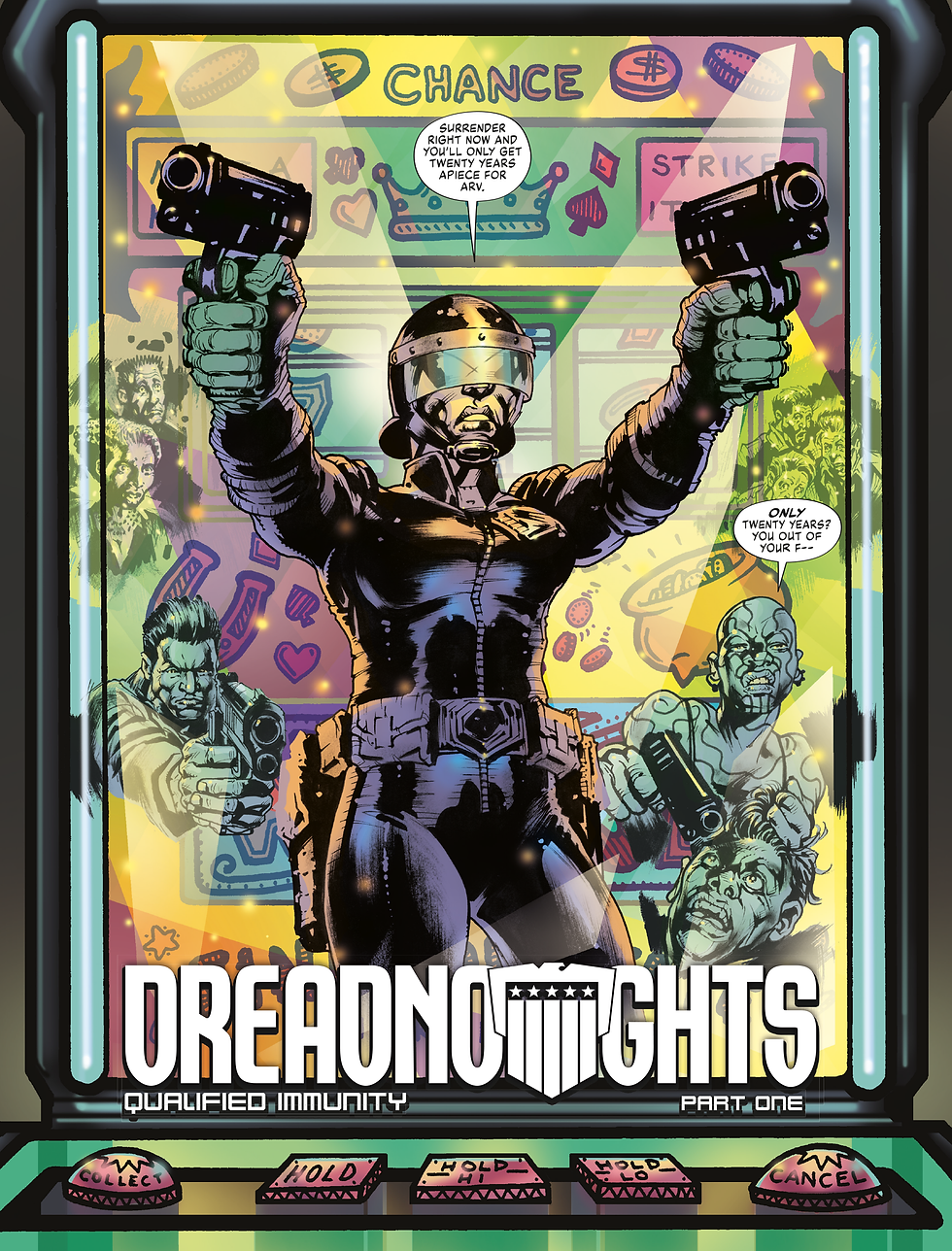
CBY: Dreadnoughts has hit me a lot harder than Judge Dredd stories later in the timeline, because it's holding up a mirror to the current state of the United States and provides so, so many warning signs about the slippery slope towards deeply totalitarian dystopia. I recall during the protests sparked by George Floyd’s murder in 2020 suggesting it be a requirement for law enforcement officers to have an actual law degree, and it sounds like this level of competency is a cornerstone of Judge training to instill confidence and substantiate their authority in embodying the Law. Considering the ICE employment drives running stateside notoriously failing to draw Judge-calibre candidates, what rationale would lead people with the critical thinking skills and capabilities necessary to become Judges to participate in such an authoritarian program? The Judge system requires a complete capitulation of legal scholarship toward reducing procedural justice to the determinations of appointed individuals and making retributive justice the priority of State efforts and expenditure. There’s clearly a lot of backstory and cultural baggage attached to characters as Judge Glover or Judge Deacon; how do you create a narrative path for character backstories that lend themselves towards assuming these Judge roles?
JH: I was surprised when Mike took us away from Judge Glover, with the story Nothing to Fear. I felt at that stage I understood what Mike was doing with Glover and I felt my depiction of her was starting to be more than just a hard face under a Judges helmet.
However, the enjoyment of not having any emotional baggage attached to the new Judge made me feel I recognized a precursor Judge of Dredd’s era. I felt comfortable depicting Judge Beckett as an unstoppable force, initially I did feel the Rambo-esque sensibility with the script, but once you as the artist start to be subsumed in the writers world, hopefully you “read between the lines” and find other depths that the writer intended to be discovered, you are getting the right collaborative sensibility and see more details for your own depiction of that world and the characters in it.
There is one scene where Judge Beckett comes back into the bar all guns blazing, and the first Terminator movie came to mind, where the Terminator goes into the disco to kill Sarah Connor, I used that sensibility using Arnold's poses, also putting the top half of Beckett in shadow, I can’t remember now if I did a highlight in his eyes as a homage to that movie character, but that was the idea behind that scene image.
MC: Well, that’s the key reason I wanted to break away from Judge Glover for a while: to show the appeal/horror of the Judge system from different viewpoints. For Glover, whose past is extremely murky, becoming a Judge was the only path out of the darkness. But I firmly believe that it’s a mistake to give every main character a Tragic Backstory. Sometimes a detective becomes a detective because they want to be a detective, not because their loved one was murdered by a lone psychopath twenty years ago but the case was mysteriously never solved.
With “Nothing to Fear” I stripped the Judge’s back-story away completely; we don’t know anything about him other than his name and the fact that he’s extremely good at killing people. He’s been completely dehumanised… and thus turned into a monster. I won’t say too much about the main Judge in “Qualified Immunity” because I don’t like spoilers, but it’s not her story, so we only see her from the cop’s point of view. In these tales the Judges themselves are secondary to the impact they have on the people and the society around them.
CBY: Playing with the perspective from which the story is told provides so much opportunity to add complexity to characters, and properly probe both moral ambiguity and absolutism through seeing how different people react to having the Judge system wedged into American society. To pull things back to the joy involved in the medium for a moment, John, I absolutely love your line work. What sort of tools and techniques have you employed to produce Dreadnoughts, and what sort of visual notes did you both lay out from the start around the approach you’d be taking toward creating a cohesive identity for the title? How has your illustration process evolved over the decades? In preparation, Mike, how much direction do you put into your scripts around the look of a scene as context for John, and what do you leave to his imagination and experienced eye?
JH: Very kind Andrew, at the start of any series you need to understand as much as you can of the characters and the world they inhabit. The characters are the most important element to get right, if you know them you can place them in Meg 1, Cursed Earth or on the moons of Titan. So the writer needs to give as much information to the artist at this stage, I usually start with an actor or research key words from Mike, to try and get an image in my mind so it starts to flow from my drawing. Then it becomes an amalgamation of many influences.
Going back to Judge Beckett, I saw a movie from my childhood called Warlord with Charlton Heston just before I started the series. One of the issues with Judges is what is the haircut under the helmet? It probably would be everyone with shorn hair, however sometimes if the helmet is off hair can be expressive, so a minor dilemma. In Warlord, the Norman warriors all had a helmet haircut. I felt like when Mike said, “some people just want to be a detective,” I thought Beckett was that “GI,” that grunt. He felt, to be a professional Judge, the best haircut was that one.
MC: I’ve known John for over twenty years and worked with him many times. He was one of my comics heroes when I was growing up, and luckily he still is! When I started out writing comic scripts I used to overload them with far too much detail: I’d picture each panel and then write the most accurate possible description to be certain that the artist drew it properly! But I quickly learned that the most important thing the writer can do is trust the artist. I can tell the artist that I think a panel should be an over-the-shoulder shot or whatever, but their instincts will almost always be stronger and honed by more experience than I have.
My job is to tell the story to John and Sally and Simon, but it’s their job to present the story to the rest of the world, so their judgement is at least as important as mine, if not more so. But not always, I hasten to add! Sometimes the writer does know what they’re talking about!
I have occasionally worked with artists who clearly just decided that the script was no more than a “serving suggestion” and then drawn whatever they felt like. Hmm… Yeah. Fun, that is not! I’ll never forget one artist – a great friend whom I only barely despise – who decided that the monster in a horror strip should look like a sort of ridiculous half-man, half- chicken. That’s one way to turn horror into comedy, folks!

CBY: Oh, definitely. After interviewing so many creative teams over the last few years, it is clear the more trust collaborators have accrued together, the greater their aesthetic shorthand, and the more implicitly the imagery of the artist imparts the intent of the writer with fewer words required. I know the same creative team has returned, as you mentioned, with Sally Hurst and Simon Bowland on colors and letters, respectively. How did they both get pulled into the project for Book One and what have they each brought to the series?
JH: They are both in the 2000 AD talent pool and Matt Smith the editor puts talent together. This talent pool has some of the best in the business and these two are both that. Simon's word balloon placement is amongst the best, placed in the most appropriate way to lead the eye from panel to panel. Sally and I work closely together, and the story colour mood is all hers. Her sense of drama and use of “exciting” colour at the right place is what I want in my art
MC: Sally is one of my favourite people on this or any other planet – we’ve known each other since long before either of us was involved in comics – so the fact that I get to work with her is the cherry on the cake. She has an incredible eye for colour and atmosphere. Plus she’s an astonishingly good artist herself, not to mention she’s a phenomenal singer.
As far as I recall, the first series of Dreadnoughts was the first time I worked with Simon, but he’s now my most frequent collaborator after Annie Parkhouse (who letters Judge Dredd). Simon’s an absolute master of the craft, but of course the Curse of the Comics Letterer is that if they do their job well then the readers don’t notice: they just immediately sink into the story. Bad lettering, however, can be jarring, ruining the flow of the tale. I’ve never seen Simon do anything other than a stellar job, and come the revolution, when I’m inevitably appointed emperor, his name will be on List of the Faithful.
CBY: I've certainly come to appreciate the quality of – and distinction between – the work of Simon and Annie after digging into 2000 AD these past few years. Regarding the landscape of other titles offering similar depictions of the near-future United States, Dreadnoughts is not entirely dissimilar to the Parable books of Octavia Butler – the adaptations of which were the subject of a recent interview with John Jennings and Damian Duffy – and has since become a heavily trafficked space in climate fiction. What sort of dystopian (or other) influences have been in your orbit while crafting Dreadnoughts? What do the deeper future and broader world of Judge Dredd provide as narrative and visual resources to draw upon and stand apart from other work out there?
MC: Judge Dredd: Origins – which is exactly what the title implies – was the key inspiration behind both Judges and Dreadnoughts. Written by John Wagner and drawn by Carlos Ezquerra – Dredd’s co-creators – it’s an absolutely fantastic tale that depicts the rise of the Judges and Dredd’s early years as a cadet. But Origins mostly focuses on the big, world-shattering events: right from the start, we wanted Judges and Dreadnoughts to deal with the smaller-scale, much more personal stuff. In fact, in the entire Origins saga the first Judges on the streets appear in only two panels. We wanted characters who aren’t seen as heroes, and they’re not saving the world every single day: they’re dealing with pushers and bank robbers and street-level gangs.
With the Judges books leaping ten years ahead with every trilogy, we were able to introduce other, more fantastical elements that are established parts of Judge Dredd’s lore: mega-sized city-blocks, interstellar space-travel, robots and flying cars and the like, but since we’ve kept Dreadnoughts much closer to today, the main differences with the real world tend to be sociological rather than technological.
JH: This is my biggest problem depicting the world of Dreadnoughts; no real opportunity to do mega sized buildings in the shape of Eagles! Totalitarian architecture is usually brutal, the human element is not considered by that world. In Dreadnoughts we are not there yet; it is what you see looking out your window. In some ways, it makes this story more chilling, but still not doing architectural flourishes I do miss. However on the last page in the last panel of this last series, I do add a small architectural indicator of that future!
CBY: Thank you for giving us something to look forward to, John. Keeping us waiting until the very end, it should be a gripping sight to see the evolution as Dreadnoughts proceeds. You’ve both taken time exploring the shift in both tone and function as Dreadnoughts gives way to the latter world of Judge Dredd. Since you both have watched the comics industry evolving over decades of experience, what sort of transformation – both subtle changes and monumental shifts – have you both witnessed and taken note of over the course of your respective careers? What should those entering the industry now know about the structure of the industry now; where do you see opportunities, and what practices have been relegated to the past?

MC: I wish I could advise people about the comics industry, but to be honest it absolutely baffles me! Even though I have thousands of published pages and some pretty successful comics (and forty-something novels!) behind me, I still have absolutely no idea how a writer is supposed to snag the attention of publishers! Pet peeve: Artists can show their portfolios to editors and receive immediate feedback – and good luck to them, I say! – but us writers don’t have it so easy because the editors have to invest more time in analysing our work. Grrr! I should have been an artist instead. It looks easy. Just put lots of lines on a page and then erase the lines that aren’t meant to be there. I could do that. ;)
Arguably, the only advice a would-be writer really needs is that they should never stop writing – practice can only make you a better writer, not a worse one – and they should never stop reading. Read everything. Pick random books that you’ve never heard of and don’t know anything about. You won’t always find gold, but it’s not about the destination: it’s about the journey and the friends you meet along the way. Also, reading bad books will help you feel better about your own writing.
Regardless of where my career might take me in the coming years and centuries, I was just about eleven years old when 2000 AD first appeared and it changed me forever, so it’ll always have a special place in my motion-lotion distribution unit. Getting my first paid gig at 2000 AD was a dream come true, and I’ve since worked with some of the very best creators on the planet. Because 2000 AD and Judge Dredd Megazine are anthologies, there’s room for experimentation. Strips like Proteus Vex and Silver are quite off-the-wall in some regards and I doubt any other publishers would have given them a chance, but 2000 AD gives them room to shine.
JH: As with Mike, so much (more) has changed since I started in the industry, when digital came in, it lost jobs for a number of ancillary contributors. Now the big issue is AI, and young artists I speak to at conventions feel that also, that is one of the questions I have been asked about more than any other so far this year. It is a major “problem” for all creative industries and no one in power is doing anything about it. We all know if there is a cheaper option available at the touch of a button, big business will press it. And if they get rid of those creative talented pains-in-the-ass at the same time, stand back and don't get crushed in the rush of that big finger.
Having said that, if we sort the copyright issues out and AI cannot use our material, then we are going to be okay. You will always need a white blank page with a talented creative person looking at it to come up with a bright ‘original idea,’ not some digital number cruncher regurgitating a million old ideas and producing soulless beauty in the “uncanny valley!”
CBY: Thank you both for providing some insight from the depth of your experience, gentlemen, and regarding AI, I agree wholeheartedly with the inception of new ideas requiring humans exploring uncharted conceptual territory, John. Also, Mike, once our readers have gone through Dreadnoughts, what unrelated comics, films, music, literature, and other art would you recommend everyone give their attention to next? What other creations have been inspiring both of you lately?

MC: To my shame, right now I’m not really reading any comics other than 2000 AD and Judge Dredd Megazine. I don’t like to read other people’s work when I’m creating something brand-new – which I’ve been doing a lot this past year – because traces of anything I read inevitably find their way into my own writing! If you knead bread and eat Doritos at the same time, well, there’s an increased risk of ending up with Doritos-flavoured bread. Actually, that sounds delicious…
But the point is, since January I’ve written book three of Silver for 2000 AD, a novella that I can’t talk about yet, five twenty-page issues of a new series that I also can’t talk about, a thirteen-episode new strip for 2000 AD, and a full-length science fiction novel that I just finished yesterday… So no time for reading fiction: non-fiction only! I’ve got a far-too-big stack of comics on the To Be Read shelf that’s been calling to me… I’ll get to them soon, I promise!
JH: Sorry Andrew, every single thing I read and watch, pings relentlessly in my creative cortex, the list would be so long, even not taking into account old classics I revisit. I saw The Bishop's Wife last night, a feel good old Hollywood Christmas movie in the vein of It's a Wonderful Life. There is one scene where Cary Grant's angel says something to the Bishop (I don’t want to spoil it for anyone, so I won’t say what.) He suddenly becomes chilling, scary and an immortal being. See something that speaks to you, then tell me in your words, your pictures. That's what we can all do if we are inclined too.
CBY: Mike, that is a laudable output by any stretch, and is inspiring me to keep up the pace. John, I've always wondered what The Bishop's Wife would've been if they'd stuck with the original casting of David Niven in Grant's role - I don't think it would've had quite the warmth and humour that makes it such an enduring Christmas film. Gentlemen, it’s a distinct honour to have you both stop by the Yeti Cave to share your wealth of experience with our audience. If you have any publication, portfolio, or social media links you’d like to share that we didn’t include above, we’ve reached the time and place. We look forward to seeing how the rest of the story unfolds!
MC: Thank you! Please check out my website at www.michaelowencarroll.com and my comics blog Rusty Staples at michaelowencarroll.wordpress.com – it’s mostly about British comics but there’s a lot of fun stuff there!
JH: Well, just check me out now and then on Google if you like what I do, there is quite a bit out there after 40 odd years and counting! : )
Like what you've just read? Help us keep the Yeti Cave warm! Comic Book Yeti has a Patreon page for anyone who wants to contribute: https://www.patreon.com/comicbookyeti


