


R.J. COLLINS takes us for a spin in ARKS: HELICES

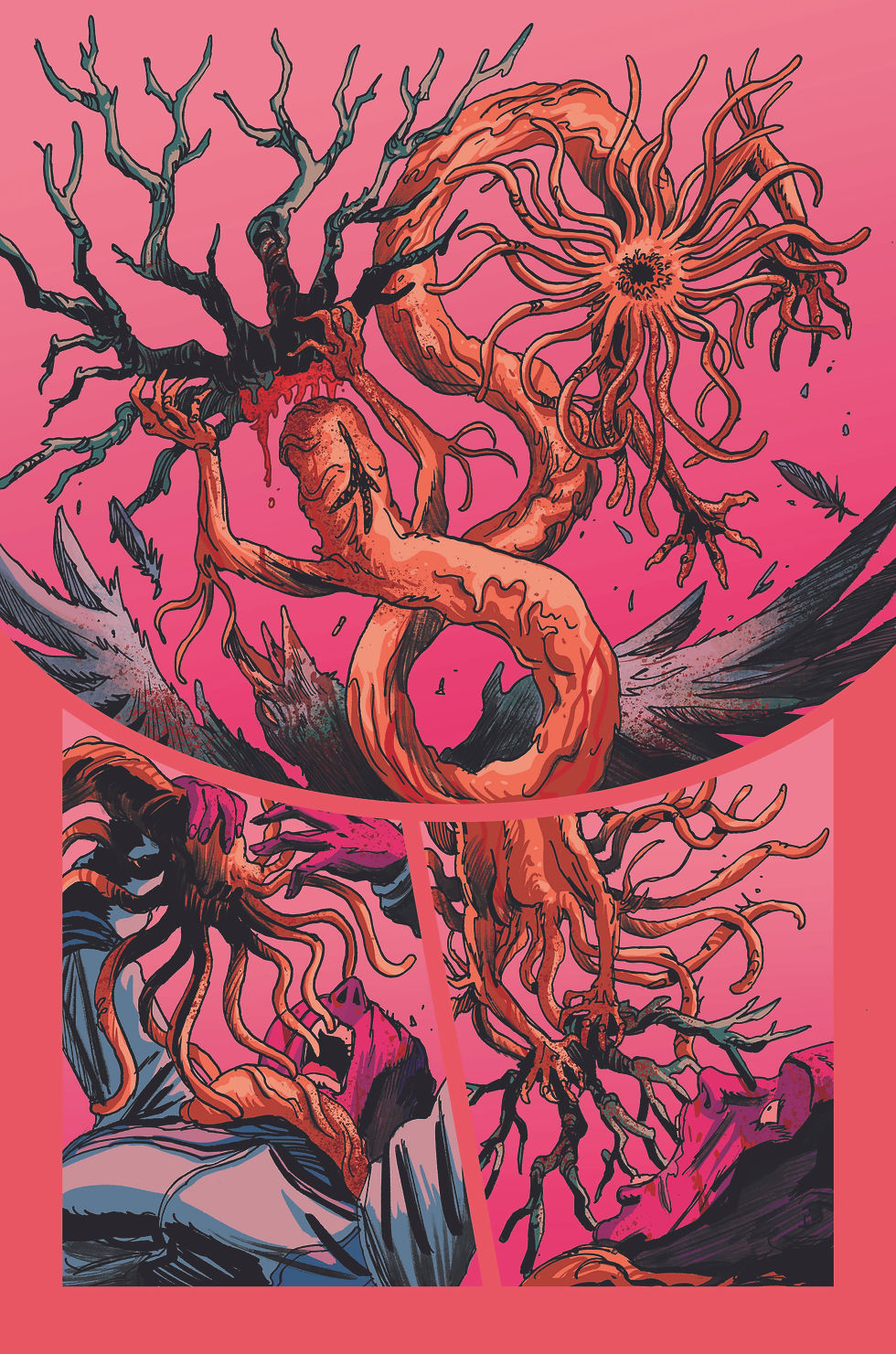
Interviews Editor, Andrew Irvin, is back with R.J. Collins, creator of the ongoing series, Arks, which is now spiraling through a new side story with Arks: Helices on Kickstarter now!
COMIC BOOK YETI: R.J., thanks for popping by amidst your campaign for Arks to chat about this new series. How’s everything going up in the U.K. at the moment?
R.J. COLLINS: The glorious boggy weather has returned after an endless summer. So I'm very happy.

CBY: Ah yes, here's to living the #boglife. To proceed, I want to start with some praise for the world-building you’ve engaged in for Ark, including maps, glossary descriptors, and well-nested exposition within dialogue. We’re now three issues into Arks: Helices; how did this journey start over a decade ago, and as we pick up with you today, where are we in the process of seeing this story unfold? Can you set the stage without spoilers to bring folks up-to-speed?
RJC: Arks started as a screenplay over a decade ago – a police procedural in the Garden of Eden, built around research into how we might spread life beyond Earth. Over the years, more and more of the ideas I’d been researching started turning up in the news, which was a strange feeling after spending so long living with them. Then Covid came along, and we became a Covid comic: I started adapting the screenplay and doing the artwork myself.
That grew into The War of Light, the wider story connecting these books. Arks begins with the attempt to seed life on another world; Helices takes us into the far future, with a detective story among the remnants of humanity around a dead star. These three issues complete the first Helices storyline, while we’re continuing to develop the other parts of that universe.
CBY: I immediately came to appreciate the deep future scale you're working within, and how you've connected the different vignettes over huge amounts of time and space. You’ve been effusive in your appreciation of science when speaking with other comics journalists, which is not often the route conversations take around the medium. Before we dig further into your cross-disciplinary inspirations, can you share a bit about your background with comics and your path from film & television production toward focusing your efforts on the page? What did you enjoy reading before you started creating your own comics, and what did your path leading up towards producing your own work entail?
RJC: I was obsessed with the Dark Horse Aliens comics in the nineties – Aliens: Genocide and Aliens: Colonial Marines. That fairly realistic science fiction was always my thing. I started working in film and television in 1999, in the art department on Band of Brothers, and later worked in storyboards and concept art on films including Children of Men and The Bourne Ultimatum. Alongside that, I was writing my own scripts, including Arks.
During Covid, a friend suggested adapting Arks into a novel. I went one better – or made things considerably harder for myself – and decided to make a graphic novel and do the art myself. One thing led to another, and now I’m making comics more or less full-time until it becomes a huge success or I flame out.

CBY: You've definitely jumped into your comic publication efforts headfirst, and have put an ambitious and impressive timeline of releases together for your readers. Arks is transpiring within what you’ve entitled The War of Light Roadmap. When creators stop by with titles yet to complete their storylines, I often ask how they envision things progressing and concluding. You’ve got a six-volume, 40-issue main run planned, with seventeen additional issues across four limited releases planned in the same narrative world. From the couple issues I’ve read thus far, there’s a lot of terminology unique to this universe and features requiring familiarization by the readers. What sort of methods do you employ in plotting your stories, making your scripts clear to your collaborators, and keeping your continuity clean?
RJC: I was born in the eighties, so I like gory, pedantic police procedurals. That probably explains quite a lot about Arks. At the beginning, the science was so strange that I was slightly self-conscious about people rejecting it, so I probably laid the explanation on a bit thick. I’m trying to wind that back in the newer stories. The research is still there; I’m getting better at deciding how much needs to be on the page.
I plot everything in a word document which, to the untrained eye, probably looks like a serial killer’s manifesto. Because these stories are mysteries, continuity matters enormously, and that can be demanding for the artists. I drove Andrew mad on issues #4 and #5 with the snot and algae – where it was, how much there was. You find yourself writing very serious notes about snot.

CBY: You mentioned art from Andrew Morris, but I note as your artist on Arks: Helices, you’ve enlisted Gustaffo Vargas, who was stopping by the Yeti Cave before I came around, and he hasn’t been a stranger here. How did you meet, and what about his work led you to decide he was the right fit to bring in to help shape the visual landscape of Arks? You’ve worked with Andrew Morris on the interiors for Arks issues (including Arks: Proximan), and he provided some fantastically gnarly cover art for Helices #1. What led to the change-up on the team?
RJC: I met Gustaffo on the convention circuit in the UK and loved the colour and vibrancy of his work. At Thought Bubble a couple of years ago, I asked whether he’d be up for doing sequential art on one of our books. He looked a little confused at first, but a couple of months later he got in touch saying he’d enjoyed Arks: Proximan and would like to work together.
Of course, I didn’t actually have a script for him. I had lots of notes for future stories, so I sat down and wrote Helices over two months. He’s been a dream to work with. Andrew’s been working on Arks: Proximan #2 while Gustaffo’s been drawing Helices #1-3, so we’ve had both stories developing simultaneously.

CBY: You've definitely played to Gustaffo's strengths, and the book looks beautiful. To that end, you’ve had a number of collaborators involved. You’ve credited Matias Zanetti with lettering, whom you’ve worked with before. I know your partner/spouse Holly is credited with producing the comic, but you’ve also got J.J. Drucker credited for co-production. Can you share a bit about all the various people involved in Arks over its development and the ways in which they have supported delivery of your vision?
RJC: If you talk to Holly - she says she does nothing. But the truth is that she pretty much helps with everything. Her main creative role is as my story editor, but she also helps with all the admin, fulfilment and shipping, and handles our social media -alongside a full-time job as a scenic painter in theatre. Jacob, credited as J.J. Drucker, helped us with admin and script reading too. He’s a great young talent, and we’ve really appreciated his support.
Matias Zanetti is based in Argentina and is an incredible letterer. He’s an incredible pro and a dream to work with.

CBY: From the finished comic, you've clearly pulled a stellar team together. You mention in your GoCollect interview from 2022, “somehow pop culture got really behind the science.” I immediately gravitated to your glossary and other minutia that does a thoroughly enjoyable job of filling in the cracks that could otherwise remain in this world, and achieving that detail without losing narrative utility is no minor feat. My own hard sci-fi literature review involves a lot of daisy-chaining existing peer-reviewed journals across disciplines - and I’m right there with you. There are absolutely mind-bending findings dropping at an accelerating rate that the genre is not keeping up with to explore the full ramifications of what we’re learning about the universe through narrative. You mentioned in UK’s Comic Book News interview how heavily scientists have influenced your approach – what do you think the evidence base provided by science adds to the process of building a narrative that untethered fiction stories cannot achieve alone?
RJC: I want to imagine the future using what we know now. A lot of our ideas about it still come from what people imagined decades ago; Flash Gordon, spaceship serials and so on. Culture acts like a copying mechanism, repeating and reinforcing those old ideas. With Arks, I wanted to step outside those inherited assumptions and ask how we might actually do this.
I’m science-adjacent, rather than a scientist. I read papers and do a lot of research, and I find the possibilities absolutely mind-bending. It’s strange how far our familiar science-fiction worlds can drift from that. Saying I want stories grounded in reality sounds terribly dry, but the research keeps taking me somewhere stranger and more exciting. I want to see where those possibilities lead.

CBY: In support of the Helices releases, you’re now running your ninth Kickstarter campaign (with a tenth for Arks #6 on the way). You’ve had successful campaigns with every effort, almost all of which have earned double the funding target or more. What have you learned over the process of setting up these campaigns; what works, what doesn’t, and what have you introduced for this campaign that may not have appeared in previous efforts?
RJC: Build a mailing list, and start early. We only started taking ours seriously this year; before that, we were largely winging each campaign. Give people regular updates and get them interested six months before your books launch, rather than starting three weeks beforehand.
CBY: Thanks for sharing sound advice I'm sure many of our readers can put to good use! I also always appreciate when spouses are able to collaborate in the creative process. It’s something my wife and I try to do whenever we can find the means and the reason, and it’s great to get other perspectives on the division of labour, and the division between labour and personal lives. How did you two meet, when did you start working together on your own projects, and what experience can you share around how you navigate your involvement in each other’s endeavours at various levels?
RJC: Me and Holly met many years ago on a short film set. We’ve both worked in TV and film for a time, and she’s now a scenic painter in theatre. During Covid, I felt it was now or never to start making my own books, and she very kindly offered to help get them off the ground. Her input into the stories is a huge part of it. I couldn’t do this without her.
We’re actually pretty good at keeping a balance. I make a conscious effort not to talk about the books all the time. When there’s something we need to discuss, I’ll give her some warning – sometimes days ahead – rather than just blurting it out. It gives us room to have a life together as well as making the comics.

CBY: Scheduling work meetings with your partner outside of regular domestic life seems like a great idea (that would also demand a lot of discipline and restraint). We’ve now talked a lot about the broader scope of the Arks universe. Clearly you have a dedication to the publication schedule and deepening your exploration of this world, but what other stories might you have on the back-burner or brewing in parallel, and how would you like to see them brought to a public audience?
RJC: We’re potentially looking at fifty-six books, and we’ve made ten, so that’s another forty-six to go. There’s a fairly good chance Arks will be my life’s work. I do have other stories I’d love to develop if the opportunity came along, but making another forty-six comics already feels like a fairly mental challenge. At the moment, it’s all Arks. Never say never, though.
CBY: It's good to have clarity in purpose and direction for your efforts, I would imagine. To close, turning attention from Arks toward the wider world of creative work; what other comics, films, music, literature, and other media has been inspiring you lately, unrelated to your own creative endeavours?
RJC: I’ve been enjoying the YouTube renaissance in filmmaking- things like Weapons, Obsession and Backrooms. It’s exciting to see stories that don’t feel as though someone’s read Save the Cat or Story and followed the instructions. There’s so much that feels engineered to please everyone but doesn’t really speak to anyone. Those films have been a refreshing change.
CBY: Yeah, letting stories roam freely away from the conventions of the Monomyth provides a nice change of pace. R.J., I’m glad we were able to make time to chat about Arks. If you have other portfolio, publication, or social media links to share, now is the time and place!
RJC: Have a look at our Arks: Helices Kickstarter, and visit clickysproutwife.com, where you can download a free copy of Arks: Proximan #1 by signing up to our newsletter. Thanks for having us!

Like what you've just read? Help us keep the Yeti Cave warm! Comic Book Yeti has a Patreon page for anyone who wants to contribute: https://www.patreon.com/comicbookyeti


