


DUSTIN HOLLAND and JEFF ALFORD Re-envision LORD DUNSANY's classic, THE GODS OF PEGĀNA

Interviews Editor, Andrew Irvin, is joined by Dustin Holland and Jeff Alford, with a new edition of Lord Dunsany's The Gods of Pegāna on Kickstarter until Friday, March 6th!
COMIC BOOK YETI: Dustin and Jeff, welcome to the Yeti Cave! Thank you for sharing your illustrated rendition of The Gods of Pegāna. Can you introduce yourselves through your first experience with the writing of Lord Dunsany – the original author?
JEFF ALFORD: Thank you for having us! My name is Jeff, I’m a big book collector of both literature and comics, ranging from old first editions to contemporary self-published zines. One of my favorite things to do is show people things from my collection and try to share the excitement of a rare book. Around 2018, I started Wig Shop, an online shop that specializes in alternative comics and self-published zines – I found this was a great way to scratch that itch and spread the love of limited-run publications.
Years ago I fell hard for old Arkham House first editions. Arkham House was a publisher that was started in 1939 by August Derleth and Donald Wandrei. They published the first collection of Lovecraft’s short stories and went on to put out this incredible body of work of stories and novels from his “circle.” My interest in this led me to discover Dunsany’s work, which was basically published a generation earlier and influenced the whole Arkham gang.
Our publication of Pegāna is effectively merging two worlds of books that I love, and hopefully will introduce fans of the two realms to each other.
DUSTIN HOLLAND: Thanks for taking the time to chat! I’m Dustin. I make comics and collages and paintings, I love books, and I’m always a sucker for a big, ambitious project, so when Jeff reached out to me about working on this, I was thrilled. I may have read the occasional Lord Dunsany short story or poem, but Jeff showing me The Gods of Pegāna was my first real introduction to the writer and the book. Now I’ve re-read The Gods of Pegāna more than any other book. It’s a real joy to read, and I hope our new edition gives folks a chance to discover Dunsany’s wonderful work.

CBY: It's always worth digging through our conceptual precursors, particularly when talking about the imagery and ideas that have emerged across the range of genre fiction, and Dunsany doesn't tread lightly. Can you both share a bit about how you initially developed an interest, and then a career, in comics? What has your journey into the medium looked like over your lives, respectively?
DH: My brother turned me onto comics when we were kids. We would dig through dollar bins for Dick Tracy and Justice League and all that good stuff. Kyle Baker’s Plastic Man series is the first comic I remember falling in love with. In my teens and early 20’s I got really into poetry and drifted away from comics, but my wife is a big comic fan, so she got me back into the artform and introduced me to cartoonists like Daniel Clowes and Charles Burns and all sorts of great stuff, and somewhere along the way I started making comics. Over the past five years, my day job has become more comic-centric too - first writing and editing for CBR, and now working in publicity with the amazing people at Superfan Promotions – so I have plenty of opportunities to read and study great comics!
JA: I first got into comics in the mid 2000s, after becoming an unabashed teenage book nerd. I think Chris Ware’s McSweeney’s #13 opened the world of non-super-hero comics for me, which then led me to Kramers Ergot #4…exploring each contributor’s body of work made an amazing network of “underground” comics creators to build my baseline from.
It’s been such a joy for me to build out this network and connect nodes from artist-to-artist, and Wig Shop is kind of an effort on my part to help people build their own web. Wig Shop emerged from a deep love of collecting and sharing books with people… I find a vicarious thrill to it all. I run Wig Shop outside of my day job (which is in the contemporary art work), and sharing that excitement makes it all worth it for me.

CBY: Dustin, it's been great to learn about so many brilliant titles through your work at Superfan Promotions over the past few years. To that end, Jeff, I've long enjoyed McSweeney's, but Kramers Ergot is a publication I'll need to find. Now, regarding this title, this is not a conventional comic, in that it’s an illustrated edition of a classic story by the aforementioned Lord Dunsany, noted for his popularization of “club tales” revolving around an ensemble of characters recounting other stories around drinks in pubs. You could have adapted any story, including many other Lord Dunsany titles; why select The Gods of Pegāna for this collaboration?
JA: I think readers really love the Lovecraft connection to The Gods of Pegāna. Words like “Lovecraftian” and “Cosmic Horror” are tossed around so much these days… I think it’s exciting to share with readers where it all comes from. And the book itself is just such a rich well to draw from for visuals. It was amazing to watch Dustin conjure up all his imagery.
DH: I also think that the way The Gods of Pegāna presents itself as a mythic and/or religious text makes it ideal for the illuminated manuscript/book of hours treatment. Like, this edition could be the version of the book the people read in Pegāna.
CBY: I can see where the crossover appeal would come into play, for sure. The original edition of The Gods of Pegāna had illustration plates included from artist Sidney Sime; what sort of inspiration did this original provide, and how did you decide to differentiate your rendition from the original accompanying artwork?
DH: I love Sime’s illustrations! I feel like he achieves this really fantastic middle ground between Gustave Doré and Aubrey Beardsley - just gorgeous, elegant illustration. But, I avoided looking at any of his Pegāna stuff until after I’d finished working on this edition. I wanted all of the art to come from my relationship with Dunsany’s book rather than my interpretation of someone else’s interpretation. Too add, seeing Sime’s stuff would have intimidated the hell out of me!
JA: I loved that Dustin held off on seeing illustrations while he was working on his own. The Sime illustrations are knockouts, but I think it was a smart choice to let those exist for that time and let ours be their own creation.
CBY: I see what you mean, and having just read Doré's rendition of Coleridge's Rime of the Ancient Mariner, I think Sime soundly fits in the same category of virtuosity. Dustin, both the color and the line work are bold throughout, and the layers applied to the page add another dimension to the art. Jeff, what sort of notes did you share upon viewing pages as they came in, and Dustin, what was your process and equipment throughout the illustration of The Gods of Pegāna?
DH: Thanks! I read the book over and over again, taking notes and drawing a chapter at a time. Jeff would send me pages as he worked on the typesetting, and I’d pick my favorite images on each page. For the most part, the chapters are centered around specific gods or prophets, so those character designs would influence the style, color scheme, and approach to the rest of the pages.
With the exception of the dropcaps at the start of each chapter, I did everything on 7x10 in paper. It’s all watercolor and ink with some acrylic highlights. I melted some wax on the cover too!

JA: Dustin’s comics are really marvelous in their versatility. At one point I had a zine in stock at Wig Shop that looked like old punky Gary Panter comics, and at the same time I had a zine of collages he did that looked like these elegant Eastern European DaDa artworks you’d find in a gallery. His work can go in so many directions. I was excited to give him the reins with his illustrations, and didn’t give a ton of notes, but when we did get into it I found we were collectively discussing pushing things more painterly and scary and less cartoony. I think the book weirdly still has the semblance of a “comic” despite the majority of the book being these wild full-color chapter paintings.
CBY: Acrylic accenting a base of watercolor is a mix I haven't really tried in my own painting, but it definitely adds a dimension. Now, Lord Dunsany fabricates a pantheon of gods for this story and generates a very idiosyncratic mythology that reveals his own approach to understanding the cosmos. What sort of relationship to mythology, legend, and religion do you both bring to a piece as lofty in scope as this book?
DH: Reading myths, legends, and fairy tales as a kid helped cement my love of stories. Spending so much time reading The Gods of Pegāna has been a really fun way to get back in touch with a type of literature I really love, so I tried to bring some of that sense of wonder and excitement into the art for this.
JA: Yeah, it feels like a return to this lost time, back when we dreamt more passionately. It’s easy to feel the absence of “wonder” these days, and any opportunity to go back to a time when the unknown was really unknown feels like kind of a spiritual cleanse.
CBY: The Gods of Pegāna is being published through the Denver-based outfit, Wig Shop. Jeff, I realize you already spoke to this a bit, but can you tell us a bit about the Wig Shop approach to projects, and what sort of publishing arrangement you've structured compared to various other creator-owned and independent comic publishers operating across the market?
JA: As I mentioned above, Wig Shop is something I do outside of my regular work life, and while that inherently means the operation is limited by whatever extra bandwidth I am able to give it, it also allows me to do projects entirely on my own scope and timeline. I can reasonably do one publishing project a year, tops, due to financial and general focus limitations. That timeline thankfully worked well for Dustin, and allowed us time to craft the book into a project that we both feel a great sense of collaborative ownership on.
DH: I don’t think a project like this would be possible with anyone except for Wig Shop. First, the whole thing was Jeff’s idea! Second, Jeff was incredibly patient and open-minded with me about the work on this and really encouraged me to take my time. The illustrations on the page borders weren’t initially going to be quite so involved, but I’m so glad we decided to go all-in. Third, the blend of aesthetics and approaches to storytelling and art-making in Wig Shop’s previous publishing efforts and in all of the comics, zines and books from around the world that Jeff stocks in the Wig Shop Web Shop is really unique. We are trying to make something that functions as a reader-friendly new edition of a lost classic and a crazy art object, AND we want it to be affordable – three goals that might sometimes seem at odds with each other, but thanks to some Wig Shop magic, I think it has come together!
CBY: From what I've seen thus far, I'd have to agree with you. I also note a fair bit of the imagery in the text – and your visual interpretations of it, Dustin – includes some elements one might consider eldritch in tone, with cosmological layers beyond that which humans are meant to behold, particularly in the form of Māna-Yood-Sushāī, the creator of the other gods. This predates H.P. Lovecraft and the advent of many conventions or tropes later seen in genre fiction. What goes into depicting a fictitious world like Lord Dusany’s, conceived in parallel with the advent of pulp fiction before la literature noir was formalized in subsequent decades? How do you escape drawing too heavily from impressions left by later conventions and keep them from bleeding into such a distinct and groundbreaking story?
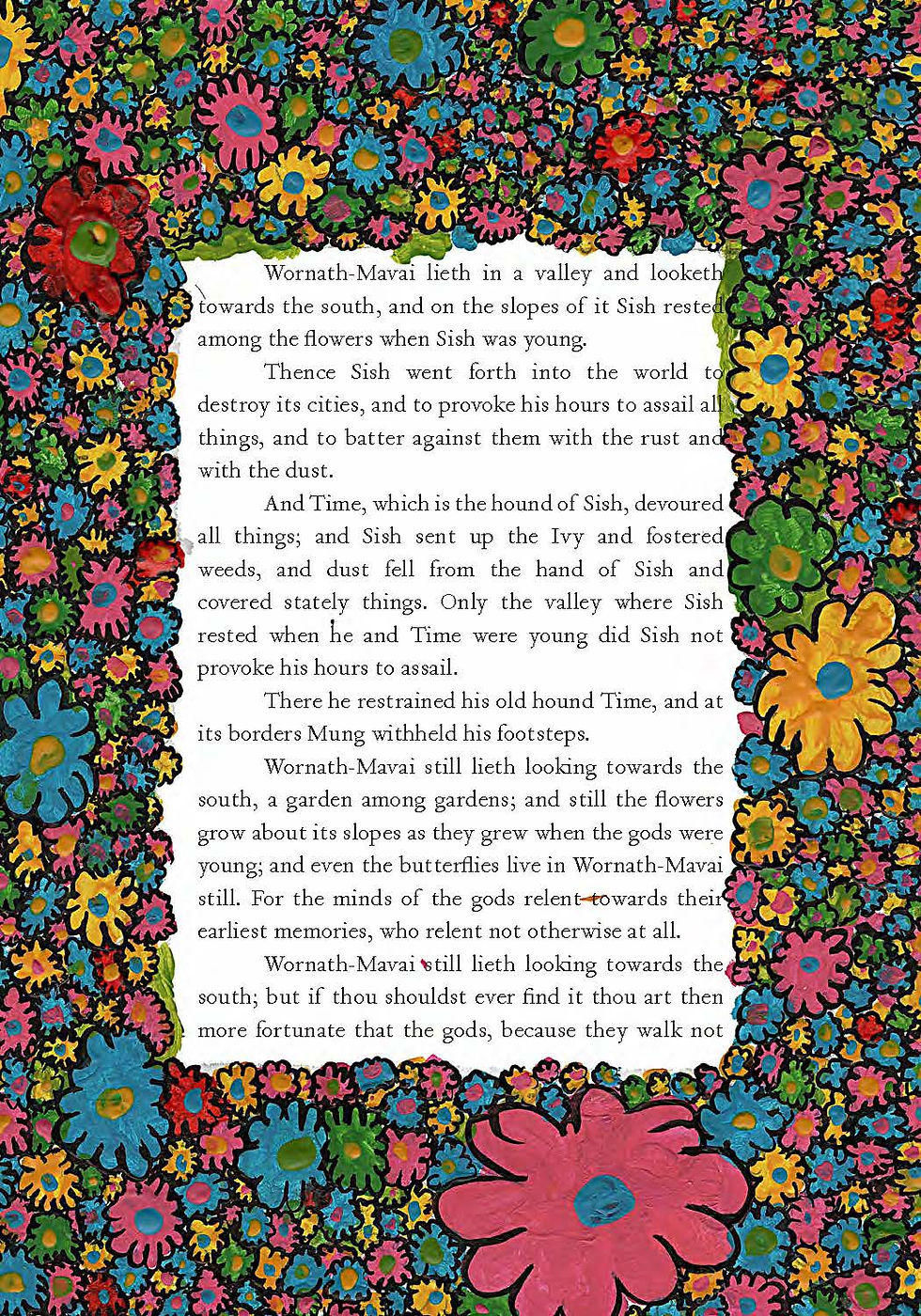
DH: I think the Cthulhu of it all is really interesting because it is tempting to view this book through the lens of all of the work it inspired, but Dunsany’s writing strikes me as really singular, and it definitely deserves to be appreciated as its own thing. Dunsany doesn’t use much visual language in The Gods of Pegāna, so while my priority was to honor the text as much as possible, I also had a lot of room for invention. I think I definitely took some inspiration from the aesthetics of cosmic horror and Eldritch stuff, but I also drew from the work of countless cartoonists, the surrealists, medieval illuminated manuscripts, Yūrei-zu, and all of the art that I love. So my hope is that the eclectic blend of influences and inspirations combined with a rigorous reading of the book has lead to illustrations that acknowledge all of the work that can exist in conversation with The Gods of Pegāna, while also celebrating and highlighting what makes this book special.
CBY: Having characters free from close description certainly opens things up to interpretation, and I think you've presented a very unique rendition, Dustin. Jeff, since you undertook the typesetting for the book, what sort of deliberation took place between the two of you around font selection, sizes, margins, etc.? How did you decide the space needed in the gutter to effectively include the planned illustrations?
JA: We started with a rigid set of rules for the size of the chapter headings, drop caps, font sizes and margins. In many instances, Dustin would paint the chapter paintings and headings independently and then effectively draw over my typeset text, filling in gaps as the text landed on the page. This ultimately created a strange tension between the text and illustration, which I think is unusual and might be divisive for readers but we both ended up really liking how it came together. It’s both calculated and unmoored: claustrophobic at times, very unusual, and I think lands in a strange realm between an “art book” and a traditional book-for-reading.
CBY: I agree that, from page-to-page, weight of the imagery shifts around the text, peppered with full-page spreads, achieving a bit more balance than many traditional print runs with chapter-by-chapter illustration plates. As mentioned, there are many Lord Dunsany stories you could turn to for subsequent publication. What is next for both of you? Are there any comics planned for your future endeavours, or projects outside the comics sphere?

DH: Some day, it would be fun to explore more Dunsany stuff! He’s got such a cool body of work! I’m currently working on helping my brother, Nick Holland, edit a book of his art and short fiction, and I’m writing and painting a comic about a secret agent spying on a house full of feral cats.
JA: There are some cartoonists I’ve had vague discussions with about projects - I hope those pan out in the coming years. An illustrated literary work like The Gods of Pegāna will be a good litmus test for the “market” – if folks like what we’ve done, I would be thrilled to do more.
CBY: I look forward to seeing what both of you come up with next (and learning what those cats are up to, Dustin!) As is customary in interviews here, I always offer guests an opportunity to share any unrelated pieces of work; comics, films, music, literature, art, etc. from other creators that have been inspiring and entertaining you lately. What should our readers check out after they give The Gods of Pegāna their attention?
DH: I’ve been watching and loving a lot of movies written and directed by Quentin Dupieux lately, and I can’t recommend them highly enough. They’re incredibly silly and really beautiful. Smoking Causes Coughing feels like an episode of Ultraman directed by Luis Buñuel, and I love it with all my heart. As far as comics go, Strangers Publishing recently released Aaron Losty’s The Hanging, which is a really beautiful comic that I recommend if you’re in the market for some haunting, bleak sci-fi. I really love Alex Graham’s The Devil’s Grin too. Her writing is incredible, and this series has it all. If you’re in the market for a killer page turner, I really loved Gary Phillips’s Violent Spring. It follows a private eye in L.A. shortly after the Rodney King uprisings who gets caught up in a twisted web of politics, real estate, and murder! I couldn’t put it down.
JA: Going back to that idea that the Dunsany will hopefully remind readers how hard we used to dream, I recommend Bi Gan’s Resurrection - a film I saw at the Denver Film Fest last year and really moved me. He’s an artist who’s also looking at “lost time” and getting back to that time of wonder. If you’re a contemporary lit person, don’t snooze on Ian McEwan’s What We Can Know, a strange sorta-sci-fi novel set in the 2100s about someone studying a poet from our current era. For comics, I was absolutely FLOORED by Marc Torices’s Cornelius, which came out last year, and channels styles and formats from the whole canon of comics.
CBY: Oh, I'll second Resurrection; there wasn't a lazy shot in that whole movie. It looks like we've got some other good recommendations to explore, so thank you sharing! It’s been a pleasure having both of you stop by, and Dustin, it’s nice to have you step into the Yeti Cave this time instead of ushering other creators over the threshold as usual. If there are any publication, portfolio, or social media links you’d like to share, now is the time and place!
DH: Thanks for such thoughtful questions! It’s always a pleasure! Folks can find me on instagram at @dustin.holland.artstuff, and I’ll be tabling at this year’s Denver Comics and Art Festival on May 9th!
JA: Thank you for having us! Wig Shop is at www.wigshopwebshop.com, and everything else is on instagram at @wigshopwebshop. And our Kickstarter prelaunch page is here.
Like what you've just read? Help us keep the Yeti Cave warm! Comic Book Yeti has a Patreon page for anyone who wants to contribute: https://www.patreon.com/comicbookyeti


