


THE MOST AMAZING SATURDAY MORNING RUBBISH CLUB Arrives, Courtesy of BILL TUCKEY and FRANCISCO DE LA MORA
- Andrew Irvin

- Dec 12, 2025
- 11 min read
Bill Tuckey and Francisco De La Mora offer an exciting all-ages exploration of accessibility and ways to create safe, enjoyable public spaces for all in The Most Amazing Saturday Morning Rubbish Club, out now through SelfMadeHero.
COMIC BOOK YETI: Bill and Francisco, welcome to the Yeti Cave! The Most Amazing Saturday Morning Rubbish Club is an enlightening slice-of-life story appropriate for all ages, with lessons to be taken away by every reader. How did the two of you meet, and when was this project first conceived?

FRANCISCO DE LA MORA: We met through Bill’s sister, Kate, about 10 years ago. Since the very beginning of our friendship, we bonded as parents of kids with additional needs, and around that time, I started asking Bill to write something I could illustrate. I had other very different ideas in mind, when Bill showed me the script and The Most Amazing... was born.
BILL TUCKEY: Fran was very persistent in trying to get me to collaborate on a book with him. I was always keen on the idea but wanted to write something that we would both have a personal connection with. It was when Fran told me that he and his son Martin had formed a rubbish club and were spending their Saturdays litter-picking in the park that the idea began to take shape. I thought there was interesting metaphor to explore around rubbish and how our society treats children with additional needs.

CBY: The degree to which this story is grounded in reality helped make it readily relatable, for sure. You’ve credited in this graphic novel your broader support team, including Emma Hayley, Jacob Ashbridge, Paul Smith, Txabi Jones, Dan Lockwood, and Jose Luis Pescador. Is there anyone else you’d like to mention who may have had a role in the completion of this title who may not have gotten thanks in the credits at the end of the book?
BT: I would like to thank Pat Parsons and Gemma Desantis who both looked after my son Alex when he was little. They showed me what love and high expectations can do for children with additional needs.
FD: One of the three children in the book is inspired by my son, Martín. While drawing his fictional avatar, Uma, I had countless conversations with my partner, Daniela—Martín’s mum—who not only contributed creatively but also appears as a character in the story. I also spent a great deal of time talking with Martín’s sisters, Luisa and Ana, the two people who know him best apart from Daniela and me. I want to thank them not only for helping me shape the character, but also for the love they have shown Martín throughout his life.

CBY: How did you land with SelfMadeHero as publisher for this title? They release a lot of graphic biographies, adaptations, and non-fiction work, so can you tell us a bit about your approach to pitching this book, and what Self Made Hero offered that stood apart from other options for young audiences across the independent graphic novel landscape?

FD: I had published two previous books with SelfMadeHero—both biographies of Mexican painters—so they were the obvious choice for this new project. I’m not only honoured, but genuinely happy to be part of SMH’s catalogue. Working with Emma, Jacob, Paul, Txabi and Dan has always been a pleasure; they are a professional, thoughtful and deeply supportive team.
BT: I rode on Fran's coat-tails with this one. Emma and the team have been remarkably supportive and trusting of our creative vision.

CBY: Not often do I encounter comics that receive public sector funding, but I note the role of the National Lottery through the Arts Council England in bringing this title to life. Was it supported through a grant mechanism or some other more indirect avenue? Can you share a bit about the process of fostering this partnership and how it differs from commercial publishing arrangements?
FD: Making a comic means spending countless hours not only shaping the script but also drawing hundreds of hours. It’s a lovely process, but extremely time-consuming. The Most Amazing took 18 months of illustration work alone. It would be impossible to expect a publisher to cover that amount of labour; the maths simply wouldn’t work. So comic artists usually seek support elsewhere—through side jobs, savings, family help, or grants. A grant is often the most realistic option.

However, the publisher is always involved in the application, because funders like the Arts Council need assurance that the book will actually be published. With SelfMadeHero, the editorial work begins with the financial planning and ends with getting the book into as many bookshops as possible. And in between those points lies everything else: design, copy-editing, printing, distribution, promotion, press, and all the invisible work that makes a book possible.
BT: I never thought we'd get funding in a million years and thought Fran was being naive and over-optmistic with our application. Turns out I was wrong! Fran's persistence is an unstoppable force.
CBY: There’s a character who appears early in the comic with full sleeve tattoos of leafing branches, and I loved this delightful added flourish to the design, as it was not strictly necessary. It particularly struck me, because I can’t recall seeing anyone with a similar tattoo design, and it looked fantastic. What sort of people in your lives, and characters across fiction, inspired you both – directly and indirectly – as you put this title together? What fed into the visual identity of this graphic novel?

BT: The characters mostly came to my imagination fully drawn and Fran was brilliant and generous in his interpretation of them. The character you refer to, a park ranger, is called General Trees, which was actually the name of quite an obscure Jamaican dancehall artist in the 1980s. I'm not sure why that tickled me and also why I asked Fran to draw him as having a strong resemblance to Begbie from the film Trainspotting. But there you go. Maybe it was something to do with the fact that heroes often come in unlikely guises.
FD: I have to give credit to Bill for most of the visual identity of the characters. He had a very clear vision of how he wanted them to look. In some cases, though, I've asked him if I could draw inspiration from people who have been important in my journey as a father of a child with additional needs. That’s the case with the carer in the school chapter, who is based on my son’s carer in primary school—a hugely important person in our family, and the person to whom I’ve dedicated the book: Carine Wood.

CBY: Another engaging visual element you’ve employed—which I adore whenever I see it—is the inclusion of some very dense, text-heavy panels of diegetic imagery (e.g. - posters, books on shelves, etc.), loaded with additional information. We’ve talked about your human inspirations for this graphic novel, but what inspired the decision to include so many supplementary details on the page, and are there any Easter eggs people should be keeping an eye out for as they read?
BT: I love the little details that make a second reading worthwhile and Fran must take most of the credit for that shelf. Elsewhere in the book a character appears occasionally talking a language which reads like gobbledygook, but if you read it out loud slowly and phonetically, it might just start to make sense. My inspiration for that was the Arumbaya tribe in Tintin and the Broken Ear, who, one eventually realises, are speaking in a kind of cockney rhyming slang.

FD: That's a very lovely question. Thanks for noticing the little details. The bookshelf in the chapter called The Mums was a lot of work. It has many small details: a bookend on the shelf is a “Tree of Life,” a traditional craft from a region in central Mexico, showing that one of Finn’s two moms is Mexican. On the spines of the books, you can find one called Sepa la bola, my favorite book from my favorite Mexican cartoonist, José Ignacio Solórzano (JIS). You can also see that the cover of the first LP is Led Zeppelin IV, and Connor, the carer, has a collection of amazing t-shirts. The score on page 92 is a real song, though I can’t remember which one—so if someone identifies it, please send me a note. And finally, on page 123, there is a shelf of topography books, including one called The Topography of My Soul, by none other than Bill Tuckey.

CBY: All the proximal information conveyed or symbolized through your effort really adds value and density to the page - it was delightful and engrossing, and a little metatextual self-reference is never a bad thing when thoughtfully deployed. The Most Amazing Saturday Morning Rubbish Club deals with a diverse range of intersectional accessibility issues in a way that makes their impact on the story central without pulling attention away from the narrative. When trying to educate an audience, what rhetorical tools do you both employ, verbally and visually, to illuminate the reader and motivate a change in perspective or behavior? What other fiction do you see grappling with healthcare, waste management, and other societal systems in an effective manner that inspires your approach to depicting issues through comics as a medium?
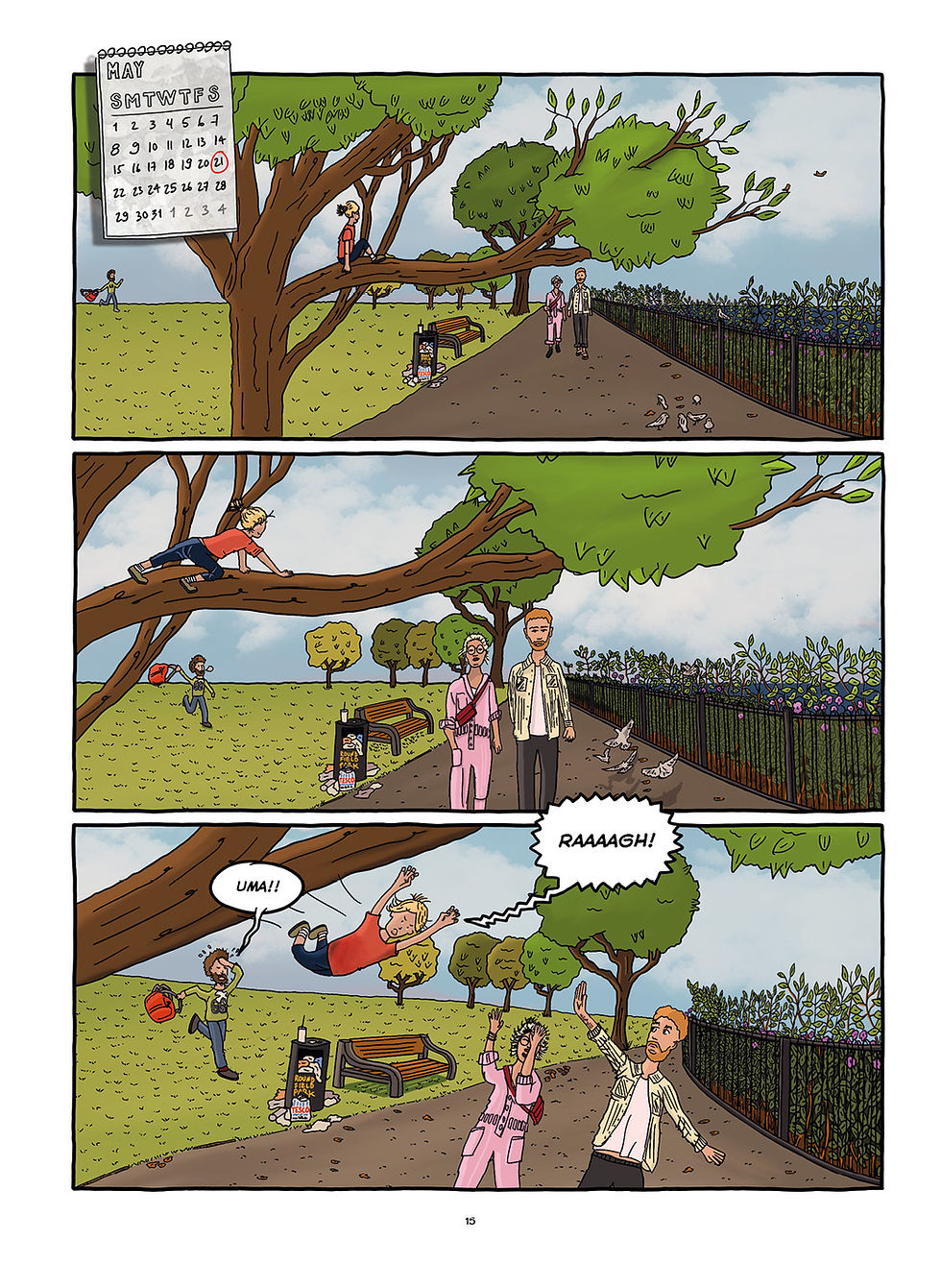
FD: I think one clever tool that Bill introduced in the book is the way Uma’s character speaks, using emojis. It makes you, as a reader, spend a little more time trying to understand what she’s saying. This mirrors real life for people like my son, whose disability makes his language difficult to understand at first, but incredibly rich once you start to catch glimpses of it.
Another rhetorical tool we introduce in the book is the “white people”: all these characters who go through life without noticing that some people need a bit more attention, a bit more consideration, a bit more help. These characters are all white at the beginning of the book, but by the end, when everybody is out of the hole, there are no more.
BT: I think the truth is the best educator and many of the incidents which occur during the Saturday Morning Rubbish Club are based on real life experiences. For example the scene in which Uma jumps off a bus and nearly gets run over. Fran and I have both had similar incidents with our own children.

CBY: Trying to keep kids out of traffic is a preoccupation I think most parents share, and I can very much relate. Now, I won’t delve into spoilers, but I want to say I admire the dramatic stakes you were able to achieve in a medium that so often interprets narrative conflict through a lens of violence. There are a number of moments where, if I didn’t know the intended audience of the book (and say, it were a Fantagraphics release instead of Self Made Hero), I see where it could have taken much darker turns. How do you play with calibrating your points of conflict in a story to fit the rhythm and scope of the story, and did The Most Amazing Saturday Morning Rubbish Club demand any new considerations or accommodations unexplored in your previous work, respectively?
FD: This is all Bill’s work, so I’ll let him answer that part. One thing I do want to say is that, as a Mexican, I am quite tired of narratives dominated by violence. Even in my home country—and also here in the UK—violence is only one aspect of life, yet it has taken up so much of popular culture recently. I’m very happy that this book avoids those darker turns.
As for the second part of the question, this was a very personal project for both of us. For me, it required several accommodations. Perhaps the most visible was asking Bill to change Uma’s character to a girl, which allowed me to create some distance from my own parenting experience.

BT: This is a book about love, ultimately. And how loving people without judgment allows them to flourish. The points of conflict occur when that vital human capacity is wanting, and we have three young heroes on the book's pages who are able to set things right. They don't need to get too heavy or didactic about it because they're very pure souls and when they speak the truth, it is unarguable.
CBY: You both very deftly delivered all these motifs of connectivity, bridging understanding between characters. I know part of this creative collaboration included the common experience of parenting children with special needs. If there is anything you didn’t get to say within the graphic novel that you’d like to elaborate upon, please take the time and space to do so here. What should our audience know about how this has changed your relationship to society, and the systems of accessibility for public services? In your respective experience, what policies and practices can we, as civil society, advocate and engage in to create a more just and equitable experience for children of all ages within the full range of accessibility requirements?

FD: I could go on and on with a thousand ideas to answer this question. The book, as readers will quickly realise, is not about our experiences as parents. We’re secondary characters in a story that is based 100% on the kids’ adventures. But there’s one chapter — the dinner-party one — that gives a glimpse of some of the thoughts and ideas we have about the whole SEND (Special Education Needs and Disabilities) universe: how we feel, how we react, and how we connect both with society in general and with the SEND community in particular.
I think I can speak for all parents of children with additional needs when I say that living this experience changes your life 180 degrees, mostly for the better. Some of us become strong advocates for better resources, better accessibility, and better integration; some of us are more reserved. But I do believe there has been a real improvement in society’s understanding of people with additional needs — more “white people” becoming full colour.
If I can give one piece of advice to anyone, it’s this: there is no loss in making an effort. Look people in the eye. Talk to them. Include them. Even if it’s difficult, awkward, or uncomfortable, that is the best policy to advocate for. Inclusion starts with oneself.

BT Fran has answered the question very eloquently. All I would add is that, in the sphere of public policy, for as long as I have been following the debate, the focus has been on funding, and the perennial claim that we as a society can't afford the support that SEND children require. I think this is short sighted and wholly wrong. A stitch in time saves nine and I've seen so many kids failed by the system who end up costing us all so much more than if they were properly cared for and their potential recognised.
CBY: Absolutely, there is a critical lack of avoided cost methodology across much of our governance and economic leadership, and until people internalize that foresight, we'll continue to have to make stronger rhetorical cases for preventative investments. Your graphic novel presents the case for this sort of action beautifully. To conclude, we offer guests the opportunity to step back from the work they’ve come to promote, and provide readers with recommendations on other work you’ve found inspiring. What other comics, movies, music, literature, and art would you suggest our audience check out after they’ve given The Most Amazing Saturday Morning Rubbish Club their attention?
FD: I am finishing a graphic memoir called It Won't Always be Like This, by Malaka Gharib, about identity and resilience.
One book that inspired me many years ago is Una posibilidad entre mil (One in a thousand odds), by Cristina Duran y Miguel Angel Giner. About the first moments of the life of Laia, their daughter, and the challenges of becoming not only a first time parent but one of a SEND child, but I think it is only available in Spanish.

BT: I’d like to give a big-up to the classic British comics of my childhood, not just The Beano and The Dandy but more obscure ones like Whizzer and Chips, Shiver and Shake and Whoopee. There's a very particular, gently anarchic sensibility to them that I think may have fed into this book in ways I'm not totally aware of
CBY: Thanks for the recommendations (and fortunately, we have been working to cultivate Spanish language readership, so hopefully they can track down the titles). Bill and Francisco, it’s been a pleasure - thanks for stopping by! Before we close, if you’ve got any other publication, portfolio, or social media links you’d like to share, this is the time and place.
BT: Thanks! I'm a bit useless on the socials but I would recommend a follow of @selfmadehero
FD: Thanks. Here is my webpage: www.franciscodelamora.com
Like what you've just read? Help us keep the Yeti Cave warm! Comic Book Yeti has a Patreon page for anyone who wants to contribute: https://www.patreon.com/comicbookyeti


