


THE ADVENTURES OF HE-MAN AND PORTER offer a take from STEPHAN PASTIS and WILL HENRY on MASTERS OF THE UNIVERSE

Stephan Pastis and Will Henry step into the Yeti Cave with Interviews Editor, Andrew Irvin, to discuss The Adventures of He-Man and Porter, out September 1st from Mattel Press.
COMIC BOOK YETI: Stephan and Will, thanks for stepping into the Yeti Cave today! How are you both doing at home on your respective coasts?
STEPHAN PASTIS: Thank you! Very well!
WILL HENRY: Thanks for having us. I’m often called a Yeti, so I feel at home.
CBY: It's good to know you came prepared to fit in with the crowd, Will! I know Mattel first launched Masters of the Universe in 1981, which was slightly before my time, so my earliest memories of He-Man involve promo clips from the television series (which my mother forbade me from watching). As such, I didn’t get into the fandom and lore during its first run. How did you both first acquaint yourselves with Masters of the Universe and, eventually, end up getting involved in creating this title?

SP: Yeah, I pretty much only knew it from the toys. So I watched over a hundred episodes of the series in its various iterations, starting in the early 1980s and going through the recent Netflix series.
WH: I also discovered He-Man and the Masters of the Universe from the original show and toys that went along with it. I had forgotten how cool the characters and premise were, so revisiting these characters and all their reinventions was so much fun.
CBY: The Netflix series slipped past me, so I might have to give it a watch since spending a bit of time acquainting myself with the franchise. Now, He-Man, while first and foremost an action figure line, was originally packaged with mini-comics to help contextualize the world in which the characters behind the toys existed. As this title is largely presented through single-panel illustrations with running prose, The Adventures of He-Man and Porter debut is not too far removed from the originally marketed format. With over forty years of reference material to draw upon for launching with “Skeletor Ate My Homework,” what elements of the Masters of the Universe lore did you most draw upon in an effort to bring this story to life?
SP: I tried to focus on; 1) the personality of each character, 2) what powers each of them had, and 3) how they interrelated with the others. Once I felt I had that down, I tried to give the characters my own spin (including putting Skeletor in therapy).
WH: For me, it was mostly visual aspects. Stephan did the heavy lifting with the character development while I scoured the decades of character designs, choosing elements that would fit my style and push the humor

CBY: Skeletor clearly has lots of issues to work through, so that was a sensible move. It is also worth noting, this title has been written with middle grade readers in mind. How do you both adjust your writing and illustration process when catering towards a specific demographic, and do you take a different approach to working with a general audience in mind as in your syndicated newspaper strips?
SP: As I’ve probably said before in regard to Timmy Failure, I really don’t write for any specific audience in mind. Whether I’m doing the comic strip or a kids’ book, I just write to make myself laugh. And when I do that, it appears I appeal to 11-year-old kids.
WH: Most of my comics are directed to a similar demographic, but hopefully have an appeal to all audiences. So, pivoting to something like Skeletor Ate My Homework felt like second nature.

CBY: I enjoyed it as a grown man with no deep nostalgia for the source material, so I'd say well done! How have you both reflected, individually and in conversation, around the process of handling IP that began as a merchandising exercise, first and foremost, (joined in the market by properties such as G.I. Joe, Jem & The Holograms, and Transformers). Mattel Press is expanding the publishing program for Masters of the Universe brand alongside the Amazon MGM-backed film, which has <$200m behind it with about $110m at the box office as of this writing. How do you understand your role in the wider creative endeavors tied to He-Man and his friends? What sort of space do you feel as though you’ve been empowered to carve out for your The Adventures of He-Man and Porter title, and how is it either confined by, or freed from, the broader IP guidelines for Masters of the Universe?
SP: Well, as to the first question, I’m pretty much in my own little space with the books. They don’t loop me in on that other stuff, nor would I really want to be. The second question, though, is the one that was important to me, and something we established early on—namely, that I would be free to make the characters my own and pretty much do what I want with them. Though there are limitations (Turns out I couldn’t have any of them die. Who knew?)
WH: Like Stephan, I was also working in my own space. It is really neat to see the project and characters you’re working on be so prominent in the mainstream media. But I worked closely with the folks at mattel to get a look that was uniquely mine but also stayed true to the source material. It was very important that the characters were recognizable but also felt fresh and in line with the tone of the book
CBY: I see you’ve taken the opportunity for The Adventures of He-Man and Porter to examine the challenges between fathers and sons around cultivating a nurturing environment in which to learn and grow. Mattel was able to establish with the Barbie film a redressing of gender stereotypes by elevating the hypocrisy of feminine-focused marketing and societal perceptions around the incongruent expectations of women in modern American society. Given the role Barbie was able to fulfill, what parallel potential do you see for He-Man and Masters of the Universe to explore and subvert unhealthy conventions of American masculinity?

SP: I didn’t focus on the masculinity stuff, but I did focus in on the father/son stuff—especially the fact that King Randor does not know that his son, Prince Adam, becomes He-Man. Which sets up this great incongruity, because the King has great respect for He-Man, but very little for his son.
WH: I think a lot of that stuff is just talking point noise. What I do know is that Stephan has crafted an amazing adventure story with some real heartfelt moments, not only with the parallel father-son dynamics, but also with Teela and Porter. I’m just hoping my illustrations can keep up with Stephan’s vision.
CBY: Wallace the Brave has been running over a decade, and Pearls Before Swine has been running nearly 25 years. From comments made by other cartoonists who produce daily syndicated comic strips, it sounds uniquely taxing. What habits and practices do you both employ to maintain consistent creative performance, and how do you partition time to work on additional projects such as The Adventures of He-Man and Porter?
SP: I’m about eight months ahead of deadline (Will is going to want to kill me when he reads that). So when I want to do another project, I just take time off the strip. For me, creativity is about input—i.e. the books, movies, places, experiences you take in. Without that, at least for me, the output suffers. It’s sort of like with an athlete—you’re only as good as what you put in your body (or in this case, head).
WH: Eight months ahead?!? Darn you! I’m pretty much up against deadlines every week, but I’ve got a good system in place, and perhaps I work well under pressure. It was also perfect timing. This was the first year both my children were in school full time; kindergarten and second grade. So I had a sliver of extra time to try something new. For me, consistency in schedule seems to fuel the creative fire.
CBY: Yeah, the dailies are formidable, and Stephan, I'm amazed you've built up that size a buffer - I am also now very curious which other syndicated strip creators (if any!) have that kind of lead time already squared away. Since you’ve both got experience both writing and illustrating comics, did your shared experience performing in dual roles change the way you interacted as collaborators, and how did you decide upon the division of labor for this title? What did the scripting, sketching, and drafting process look like through completion of The Adventures of He-Man and Porter?
SP: I knew I didn’t have the ability to draw these characters. And I knew Will did. So when Mattel asked me to write it, I said I’d do it if Will illustrated it. And for me, he was a godsend, allowing me to suggest drawings that I never could have done myself.
The process was simply me writing the first draft and including explanations for what each of the drawings should be. And because Will and I both do the same thing for a living, that required very little explanation on my part. We just think alike. I could not have done this without him. And now I’m hoping he says really nice stuff about me, too, because otherwise I’m taking it all back.

WH: The image prompts were a trainwreck, we were never on the same page. (Ha, kidding!) This was my first project collaborating with another artist and I was surprised by how smoothly it went. Like you mentioned, we’ve both been illustrators and writers for most of our career with very little outside influence. But, we both know the language of visual story telling so Stephan’s image prompts were very clear and interpreting them was actually a lot of fun.
CBY: It seems like you both found a matching rhythm in the process, based upon the final result. Noting “Skeletor Ate My Homework” is listed as #1, and I see #2 is slated for release next year, what do you both have planned for subsequent installments of The Adventures of He-Man and Porter?
SP: In a word, more Skeletor. I’ve come to love him.
WH: More Skeletor and some characters that didn’t appear in the first book. No spoilers, but book #2 is a heck of an adventure.
CBY: Fortunately, our readers don't have to wait long for book #1 to drop, with its release next week. To close, we offer our guests an opportunity to share any work unrelated to their own projects that may be providing inspiration lately. What other comics, films, music, literature, and other art has been catching your attention lately?
SP: For me, six books in a row by the Japanese author Haruki Murakami. I like his clear writing style. That, and a lot of foreign films, particularly from the director, Wong Kar-wai.
WH: I’ve been reading a bunch of comics by Jens K Styve, the Norwegian artist whose work is brilliant. Definitely check it out.
CBY: Thank you, Stephan and Will, for joining us today! If you have any additional portfolio, publication, or social media links you’d like to share with our readers, now is the time!

SP: Yes, in November, I’ll be releasing Pearls Jubilee, a celebration of Pearls Before Swine’s 25th anniversary, in which I rank the best (and worst) strips I’ve ever done.
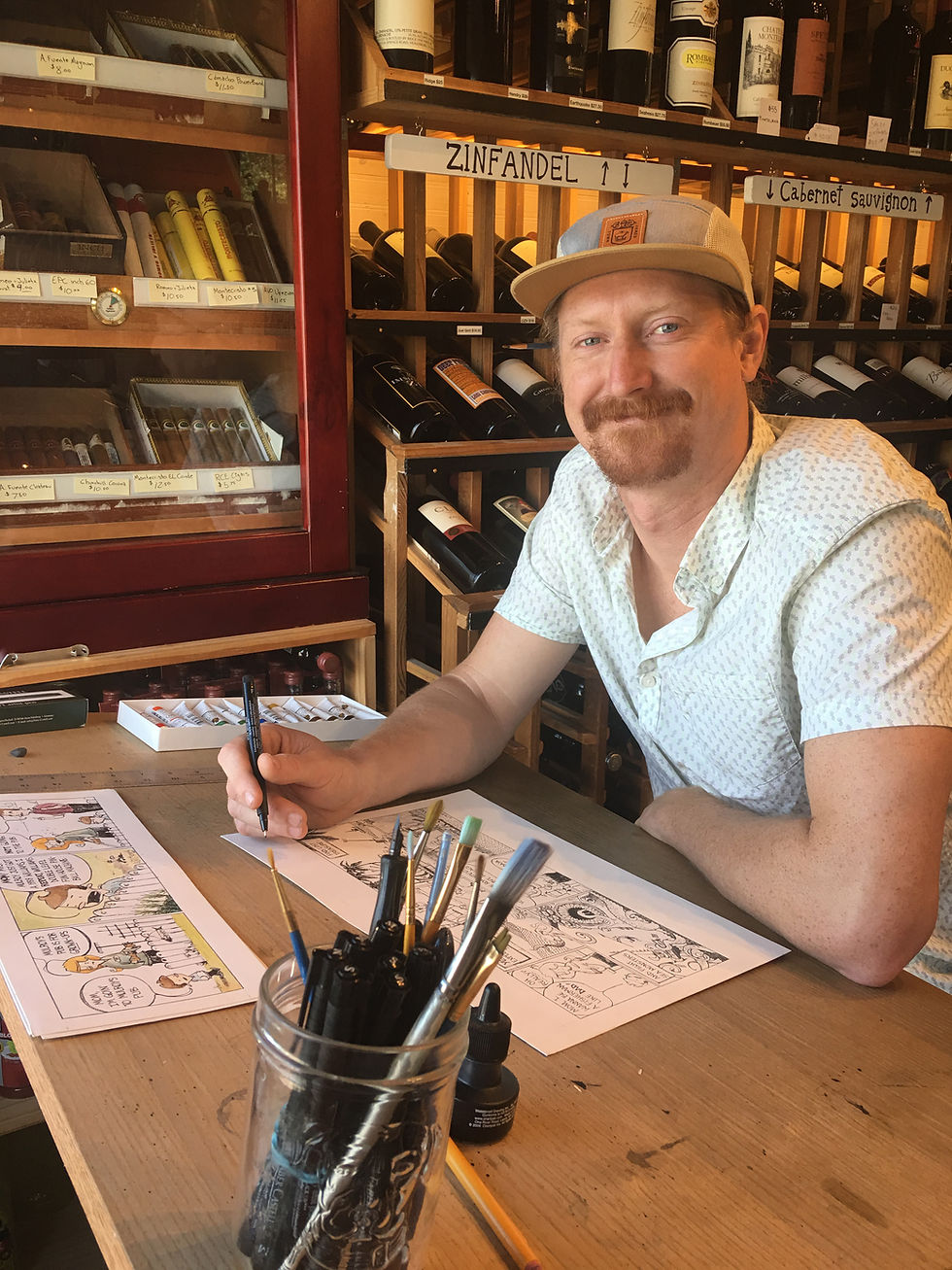
WH: Wallace the Brave, book six - "All Hands on Deck" also releases in September. Two book releases in one month. That’s a record for me!
Like what you've just read? Help us keep the Yeti Cave warm! Comic Book Yeti has a Patreon page for anyone who wants to contribute: https://www.patreon.com/comicbookyeti


