


Six Sided Seas - Board Game Review

Type of Game: Dice Rolling, Push Your Luck, Worker Placement
Number of Players: 2
Age: 14+
Designer: Kroze Kresky
Artist: Megan Cheever
Publisher: Solis Game Studio
This copy of Six-Sided Seas was provided as a review copy from the publisher, Solis Game Stuido.

There is something inherently satisfying about a pirate-themed board game. Give me a ship, a few islands, some treasure, and an opponent to blast with cannons, and I’m interested. Six-Sided Seas from Solis Game Studio takes that familiar pirate formula and strips it down to a surprisingly compact package: a roll-up playmat, a pile of six-sided dice, and a couple of glass beads. Designed by Kroze Kresky and illustrated by Megan Stojanova, Six-Sided Seas is a fast two-player game that combines push-your-luck dice rolling with worker placement. The result is a game that is easy to learn, quick to set up, and packed with meaningful little decisions.
Concept and Gameplay
At its core, Six-Sided Seas is a pirate duel. Each player commands a ship, recruits a crew by rolling dice, and then assigns those dice to different stations aboard their vessel. Those stations allow you to attack your opponent, search for treasure, explore islands, or manipulate your dice.
The clever part is that the dice you roll aren't simply resources — they're also a risk. You have a coin limit, and every die you roll adds to your total. Roll too much, and you go "Overboard," limiting what you can do with that turn. Stop at the right moment, however, and you can turn a handful of dice into a surprisingly effective combination of actions.
There are three ways to win:
Reduce your opponent's ship to zero Hull Points
Reach the top of the coin track
Control four islands at the beginning of your turn
That gives Six-Sided Seas more strategic variety than its small footprint might initially suggest. You don't necessarily have to sink your opponent to win. Sometimes the smartest pirate is the one quietly amassing treasure or taking control of the islands.
A game begins with each player taking a set of dice and a glass bead to track their coins. Players also place two dice on their ship's Hull Point spaces. In a two-player game, the first player starts with a coin limit of 12, while the second player gets 13, giving them a little extra breathing room during the opening roll.
Each turn is divided into two major phases: the Roll Phase and the Order Phase.
During the Roll Phase, you roll dice one at a time. After each roll, you have to decide whether to keep going or stop. The catch is that the combined value of your dice cannot exceed your current coin limit. If it does, you've gone Overboard.
Going Overboard isn't necessarily the end of the world, but it is a significant setback. You can place dice into your Evade spaces, provided they meet the requirements, but your turn ends without giving you the opportunity to carry out your other actions.
There is also a fun reward for hitting your limit exactly. Rolling a total equal to your coin limit triggers a Jackpot, allowing you either to increase your coin limit by one or roll another die without it counting against your limit for that turn. That creates a nice risk-reward loop: sometimes you are deliberately pushing your luck because the potential payoff is too good to ignore.
Once you've finished rolling, you enter the Order Phase. This is where your dice become workers. You place them on the various stations on your ship to perform actions.
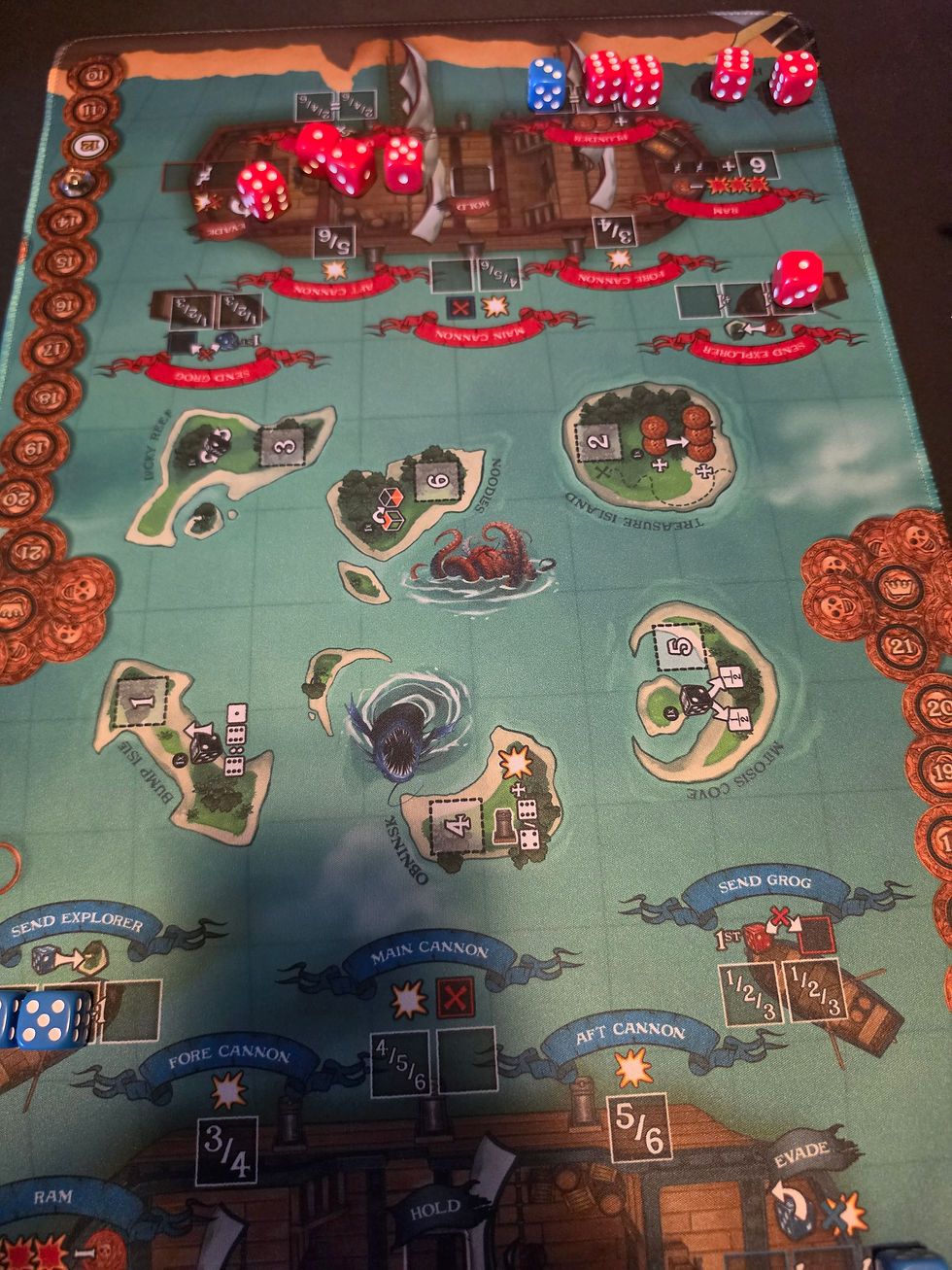
Your options include firing cannons at your opponent, sending Grog to interfere with their next turn, storing a die in your Hold, increasing your coin limit through Plunder, or launching an Explorer to claim one of the islands in the center of the board.
The islands are particularly interesting because they provide ongoing abilities. Depending on which island you control, you might gain the ability to reroll dice, increase the value of a die, improve your Plunder action, or deal additional damage. This gives exploration a real purpose rather than making it feel like a side objective.
Combat also has some nice tactical wrinkles. Cannons can damage your opponent, while the powerful Ram attack can deal three damage that cannot be evaded — although setting it up requires a specific combination of dice. The Double Time action can also increase the effect of another action, creating opportunities for some satisfying combos.
The entire process is remarkably quick.
Components
The component list for Six-Sided Seas is refreshingly simple: a neoprene playmat, 32 standard six-sided dice — 16 red and 16 blue — and two glass beads. That's essentially the entire game.
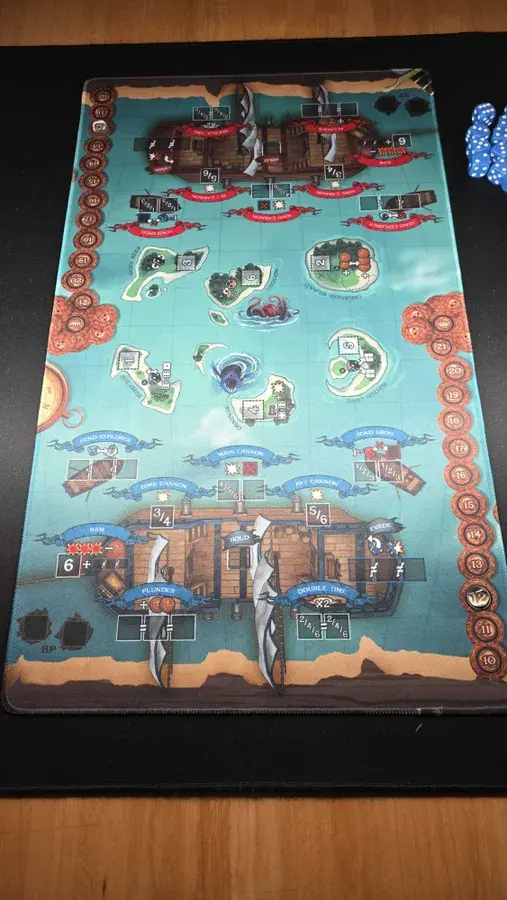
The standout component is obviously the playmat. Rather than using a traditional cardboard board, Six-Sided Seas unfolds onto a neoprene mat. It gives the game a distinctive look and makes setup and teardown incredibly easy. Roll it out, grab the dice, and you're ready to sail.
This makes the game particularly appealing for casual environments. A neoprene mat is less cumbersome than a cardboard board, and it gives the game a degree of durability that suits its intended personality. The dice themselves are standard rather than premium custom pieces, but that's hardly a problem. You get 32 of them, and the straightforward components keep the game affordable and portable.
The artwork and graphic design also do a good job of selling the theme. The central islands and opposing ships immediately communicate what you're supposed to be doing, while the various stations are clearly laid out. Some icons may require a look at the rules during your first few games, but the overall presentation is approachable.
Final Thoughts
Six-Sided Seas is a good example of how a game doesn't need a huge component count or a sprawling rulebook to deliver meaningful decisions.
Its biggest strength is the way its mechanisms work together. The push-your-luck dice system creates tension, while the worker-placement element gives those dice purpose. Every roll asks a simple question: "Do I risk one more?" That question becomes more interesting because the answer depends on what you're trying to accomplish.
Maybe you're close to increasing your coin limit. Maybe you desperately need another crew member to complete a cannon attack. Maybe there's an island ability that could turn a mediocre roll into a winning combination. Or maybe you've already got enough and the smart move is simply to stop.
Ultimately, Six-Sided Seas succeeds because it knows exactly what it wants to be. It's not trying to replace a sprawling pirate strategy game. Instead, it offers a concentrated dose of dice-chucking, risk-taking, treasure hunting, and ship-to-ship combat that can be played in the time it takes to finish a cup of coffee.
For players who enjoy push-your-luck mechanisms, dice games, and head-to-head competition, Six-Sided Seas is an easy game to recommend. It's compact, accessible, thematic, and — most importantly — fun to play. Sometimes you don't need a massive game box to set sail. You just need a mat, a pile of dice, and the courage to roll one more.
_______________________________________________________________
Like what you've just read? Help us keep the Yeti Cave warm! Comic Book Yeti has a Patreon page for anyone who wants to contribute: patreon.com/CryptidCreatorCornerPod


