MYFANWY TRISTRAM Shares Tales of Welsh Resistance in NOISY VALLEY: THE ART OF PROTEST

Myfanwy Tristram sits down with Interviews Editor, Andrew Irvin, to dive into Noisy Valley: The Art of Protest, available now, published through SelfMadeHero.
COMIC BOOK YETI: Myfanwy, welcome to the Yeti Cave! We appreciate you joining us to discuss Noisy Valley: The Art of Protest. There’s plenty around the world that merits objection. What’s the latest act of civil disobedience to inspire you?
MYFANWY TRISTRAM: Hi! Thanks for having me. Call me Myf, everyone does.
Yes, we’re living through remarkable times, aren’t we? And unfortunately there is a lot to protest about these days.
One thing that’s inspired me recently is good old-fashioned community organising. My home town of Brighton recently got wind of a planned far-right anti-immigration march coming our way. As a city that’s long been recognised for its tolerance and creativity, the population as a whole clearly just thought, “Hell, nah.”

Word went out and the upshot was that a tiny contingent of right-wingers was surrounded by a crowd of several thousand cheerful, singing counter-protesters. The police eventually led them back to the station and sent them home. It’s worth looking up the aerial photos (fourth image here) to see just how many people flooded this one street, with a little pool of anti-immigrant demonstrators surrounded by police in high viz.
I guess that’s the silver lining in difficult times: having to push back brings people together, forges new communities, allows you these moments of creativity and - defiantly, given the circumstances - joy.
CBY: Creativity and joy are an appropriate response to counter hate and destruction. Perhaps we might start by taking this back to the origins of your interest in both protest and comics; what was your first experience with each, and when do you first recall seeing the two forms of expression combined together?
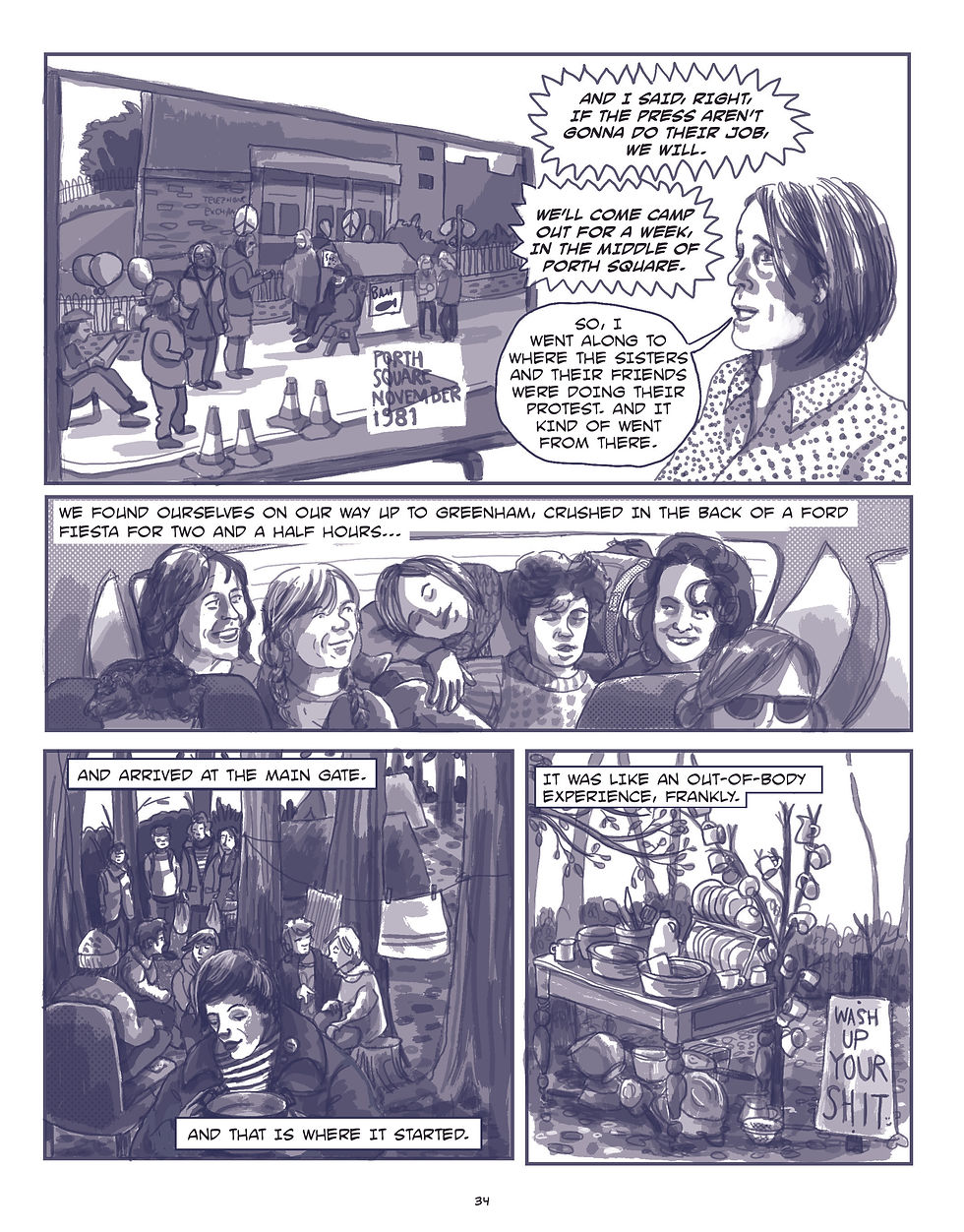
MT: I grew up in the 80s, and my first experience of protest was at home — my mum was a very active member of our local branch of CND, the Campaign for Nuclear Disarmament. She was membership secretary, so the house was full of typed and mimeographed newsletters, badges, leaflets, and so on. We were often taken to meetings, vigils, fundraisers - and on one occasion, the peace camp at Greenham Common, though that was just for a visit, we didn’t stay. CND was a major part of my mum’s social life, with people dropping in and out of the house, or us going to theirs, and I suppose that must sink in and be part of what forms your character when it’s just what’s normal at a young age.

As for my first experience with comics, I was very fortunate that while my upbringing was quite frugal, the one thing my parents were always happy to buy was reading matter - and when we were young, that meant comics. My older brother was obsessive about comics, so again, they were always there, a large part of my life. I would have started off on Twinkle, Pippin and Playhour, then onto the Beano, Whizzer & Chips, the girls’ comics like Spellbound and Bunty. We had all the Asterix albums, which I guess my Dad particularly approved of because he was a lecturer in Classics, and there was that element of Roman history. So yeah, I’d be confident in saying we were more exposed to the comic form than most. And of course, when you’re reading comics that much, the language of speech balloons, thought bubbles, sound effects, and captions becomes second nature.
As to when I first remember seeing the two forms of expression combined, I think that must have been with the appearance of Crisis in the late 80s. I consider myself lucky that just as I was growing out of kids’ comics, along came some really good comics for teens, most notably Deadline but I do remember also buying Crisis. While Deadline had a focus on pop culture and general silliness, Crisis, from the makers of 2000 AD, was tackling issues like animal rights, Tiananmen Square, race relations and conditions inside prisons. Although, when you think about it, 2000 AD wasn’t exactly apolitical, albeit the lessons were wrapped up in comfortingly palatable science fiction, so strictly speaking, I suppose that came before Crisis for me.
CBY: 2000 AD has set quite the precedent. However, in recent conversation over Dreadnoughts with Mike Carroll and John Higgins, we spoke about how more than four decades of Britain's sci-fi writers weren't able to predict quite how rapidly due process would unravel in the United States. You’ve written and illustrated this graphic novel entirely, but credited are Emma Hayley as Publishing Director, Txabi Jones as Designer, Paul Smith as Publicist, Jacob Ashbridge as Publishing Assistant, with thanks to Corinne Pearlman and Nick de Somogyi for their consultations, and a dedication to Tabs. Would you like to make mention of anyone who didn’t go down in writing at the time of publication for their role in bringing this book to life?

MT: Yes - there’s actually a longer list of acknowledgements at the back of the book, including, most importantly, the Workers Gallery, who made the whole project happen when they invited me down to the Rhondda Valley to exhibit my pictures. As I discovered, Gayle (Rodgers) and Chris (Williams) are doing something amazing, providing a cultural beacon in a quite deprived area of Wales, not just a gallery but also a meeting place, a library, dementia support, and in winter, a warm place where people can go if they can’t afford to heat their own homes. It was Gayle and Chris who introduced me to the people who feature in the book - without them, I would have just been this person parachuting into a small community and demanding stories, which wouldn’t have worked, I don’t think!
The other person who gets a heartfelt acknowledgement at the back of the book is my partner, Joe: as anyone who makes comics knows, it’s a time-consuming task, and, as I was doing it around my day job, Joe really had to pick up the slack in making sure the house didn’t turn into a complete tip. We should all acknowledge the labour of cleaning the toilet, doing the laundry, and mopping the floors that is behind every long-form comics project!
CBY: At the tail-end of a PhD., I keep finding new ways of showing gratitude to my wife for holding our house together when I lose track. I also know of the example set by the Greenham Common Peace Camp from my involvement in the nuclear disarmament discussions around the Pacific. For our readers who aren’t acquainted with the particulars of Great Britain’s geography, can you tell us a bit about Wales, its specific dimensions of subjugation and mistreatment by England? What makes Noisy Valley such a place-based title?
MT: I hadn’t planned to make a comic set in the Rhondda - in fact, before being invited to exhibit there, I didn’t know the area at all! Like many, I vaguely knew about the miners’ strikes, and had seen the film Pride - that was about the extent of it. The graphic novel really just came about because I thought that, while I was down there for the exhibition, I’d fill my time by asking people about their memories of protest (since that was the topic of the show) and turn them into a quick little scribbly zine.

It was only when I started hearing these rich stories that I realised I was going to have to do them justice - a zine wasn’t going to cut it. The hyper-local nature of the book came about that way. I did hear stories from a bit further afield, like Cardiff, which is about 16 miles away, but Gayle was very keen we keep it strictly to the Valleys, and I think her instinct was correct: it gives the book a coherence; and extra character. At the end of the book, I say that you could go to any community and find fascinating stories, and I really believe that, but what the Rhondda gives it is this incredible landscape of huge purple and green mountains, which I think do, in part, shape the people who live in the narrow valleys between them; and of course, the legacy of the miners’ strikes which have had a huge resonance even to this day.
So yeah, for those who don’t know, Wales is that big bulge to the west of England! It’s part of the United Kingdom but also its own country with its own language, and its own devolved parliament. It’s also an extremely beautiful country of hills, mountains and miles of coastline, with an incredible cultural heritage. But often it’s overlooked. It’s quite easy to go about your life in England and barely hear about Wales! And it’s been overlooked by successive governments as well, so many parts of Wales are areas of deprivation, with no funding, poor education and few job prospects. Famously, Margaret Thatcher dismantled the mining industry which was the main industry in the Valleys, and they were one of the fiercest regions to resist. One of the people I featured in the book said that there’s still so much anger, it’s not wise to mention Thatcher’s name even to this day.
Mind you, I don’t want to paint Wales as a place of despair and poverty! There’s more than one side to everywhere, and for example Wales has led the way internationally with its Wellbeing of Future Generations Act, the only country in the world to oblige lawmakers to take into consideration the people of the future when making decisions, leading it to measure success on measures beyond GDP, like equality, health and sustainability.
CBY: I think there's a parallel in the legislation to that of First Nations' principles shared across North America around stewardship with seven generations in mind, but proper recognition of sovereignty to fully enforce this principle is still lacking. There’s a quote I love, “...we want to show that ‘artist’ is a job like any other - it’s work.” I’ve been teaching cultural policy this semester, and a principle I’ve been trying to convey is not only is art work like any other, creativity is the engine of change, introducing new ideas that drive us forward and generate work for others. What have you seen start as a piece of art that has successfully instigated change beyond its initial or immediate audience? What do you find makes art prompt conversation and critical thought?
MT: Yes, that quote came from the Workers Gallery, explaining how they chose its name.

To answer your question, it’s something I think about a lot - is it enough to make art? Are minds actually changed by it, does society change as a result of it? The first thing I’d say is that if there was no art, we certainly would change as a society, and not for the better. The appreciation of art is part of what makes us better people - because art is basically one person expressing what is inside them and inviting others to meet them there, with mutual understanding.
But to focus on specific examples: I think of work like Rachael House’s ceramics, which just make quiet statements around issues like trans rights, feminism, and colonialism - just sentences, sitting on a plate, displayed in a gallery. We’re in such a polarised society that half of the population don’t see assertions like this in their everyday media consumption or the conversations they have with friends and family. Having them out there in a public domain like a national museum allows those thoughts to exist, shows that there is more than one narrative. You might not agree, but at least you have to think about it. And they’ll leave a legacy as well - no matter what this period is remembered for in the history books, there will be this visual reminder that not everyone agreed with the cruelty reflected in our legislation and governmental behaviour.
More immediately, I look at work from Led By Donkeys and Spelling Mistakes Cost Lives, which is somewhere between art and mass media. In case you don’t know, they both work with subvertising - using the methods of mass media advertising to put radical political messaging across. Led By Donkeys buy up billboards and use them to display the worst of what our politicians have done or said - often letting that speak for itself. Spelling Mistakes Cost Lives is perhaps more subtle, slipping ads onto tube trains that look at first glance like official government or big brand messaging, but which have a subversive message. Again, it’s putting these alternative strands of thought into places where they’ll reach those who would otherwise be receiving messages imploring them to partake in consumerism, roll over and accept acts of war, or kowtow to our tech overlords.
Their very cheekiness is part of the appeal - you’ve got to admire it and it’s quite funny to think of their targets gnashing their teeth at how they can be brought down by something as simple - and cheap - as humour. More fundamentally, I believe that this sort of dissent is a necessary part of a healthy society. If mainstream channels of expression are throttled (as we’ve seen with the restrictions of our right to protest; but also with the suppression of TV programmes that dare to ridicule the US president) we have to be enterprising about using the tools of our oppressors to get the counter view out.

Now I’m also thinking about TV programmes when I was growing up, like Spitting Image, which showed grotesque caricature puppets of politicians, in a national act of satire that everyone saw because we basically only had four TV channels. I can’t imagine anything quite so dissident or anarchic being broadcast today. Maybe that place has been taken by YouTube and TikTok.
CBY: Subversive critiques have certainly proliferated where they are less subject to oversight and censorship by media outlet owners or regulators. Regarding action on the ground, I saw you mentioned Extinction Rebellion right out of the gate. I’ve had conversations with some of them over the past few years, but I have yet to see them deploy the non-violent protest tactics I mentioned during our discussions. What sort of advice do you have for effectively sharing ideas between organizations for broadening social capacity for, and proclivity toward, protest? What approaches work best when there may be actors working to the detriment of solidarity, agitating amongst communities trying to assemble?
MT: A lot of the actions Extinction Rebellion either adopted or introduced are now illegal thanks to the UK’s Police, Crime, Sentencing and Courts Bill of 2021.
Ironically, it was their very effectiveness that, I believe, in part led to the government severely curtailing the right to protest in this country: they were just too disruptive to the functioning of every day society. There’s a page in Noisy Valley where I try to explain that there’s a push-me-pull-you effect throughout history, where governments might crack down, but then people push back, and vice versa - a tug of war in which, at any given time, one side is gaining ground, but which, one hopes (though it can be hard to see when you’re right in the thick of it and ceding advantage) always eventually returns to some sort of equilibrium.

XR was founded on a theory that if you reach critical mass - if enough people are sitting down and blocking a road, if a high enough percentage of society is on your side and willing to join those protests - you’ll win, because the policing system can’t keep up, the media will have to recognise majority opinion, etc. This was based on the founder Roger Hallam’s observation of major uprisings around the world that had been successful; the common denominator was this tipping point of support. But I don’t think he can have predicted the backlash from those with an interest in keeping the status quo in this country; or maybe he did, but XR never quite reached the numbers he’d predicted.
So now we see the law prohibiting the act of ‘locking on’ - attaching yourself to a building or vehicle; the disruption of infrastructure including motorways and airports; you can even be arrested for carrying equipment that indicates an intention to partake in such activities. I’d say these are all a direct reaction to the methods of Extinction Rebellion, Just Stop Oil, and other major protest movements like Black Lives Matter. The law means that the police can now end any protest that, “has a serious impact on people in the vicinity” - but isn’t that the entire point of protesting? Hallam himself is now in prison. In fact, I read yesterday that there are currently 286 people in UK prisons for protesting either around climate or Palestine. Bear in mind that the last big news about prisons was that they are badly overcrowded and they’re trying to bring the prisoner population down by suspending more sentences and letting more people out early.

As for successful approaches, I think I’ve probably covered this above - it’s about local community-building. And ironically, many of the tools that facilitate that are part of the problem themselves, whether that be Facebook, Twitter or Substack! What a time to be alive, eh? I’d encourage anyone to check out Paul De Gregorio and the Act Build Change movement for ample examples of how to organise, both online and in person.
CBY: Preserving the fidelity of digital community-building is another reason I've been pushing hard for a tax on bots and the establishment of a public, ad-free internet free from platform-controlled censorship, shadow-banning, and account throttling to suppress counter-hegemonic perspectives. I was in a lecture today by one of my colleagues, Prof. Alison Young, who works on spatial justice, and was discussing criminalization of protest in the U.K. - your distinction around property damage as a non-violent action gets to a divide that came up in the spatial justice conversation - the conflict between civil liberties and economic liberties - how have you seen the distinctions made between how the law serves each social imperative? What do you make of the myriad threats on freedom of expression that appear to be caused when jurisdictions prioritize freedom of markets?
MT: Yeah, I think you’ve put your finger on it here - a lot of the repression of our rights to assemble and protest are in protection of the status quo, the capitalist society, the markets which have to be protected at all costs.

As a result, it’s been in the government’s interests to paint protest as something undesirable, sinister, and illegal. Of course, it can be all of those things, but thinking back to the protests of my youth, it is also something creative, joyful, and necessary in a functioning democracy, and that’s the framing I want to reflect in Noisy Valley. Think less setting cars on fire, more dressing up, dancing, singing, playing music, and marching to make your point! Not to mention, what inspired me to start this strand of work in the first place: the inventiveness and humour of some of the slogans you see on placards. In that sense, protest is an art form in itself.
What we’re seeing now is a feature of the authoritarianism taking root across the world. But I also believe that society swings from the left to the right, over the course of decades. Nothing is permanent and there’s always a correcting force when things go too far towards one extreme. It will come. And in the meantime, I think of that saying that the best art comes out of hard times.
CBY: The iron fist of authoritarianism cannot tighten indefinitely, I'd agree, as people only have a threshold for giving up so much liberty in the interest of security. Turning to your depictions of society, you’ve got a lot of full splash pages and even some two-page spreads with detailed ensembles of characters and relevant imagery - the piece is largely monochromatic, but with intermittent full-color imagery. Can you share a bit about your illustration process; your tools, techniques, and choices involved in your decision-making process as you put ideas on the page?
MT: When I started Noisy Valley, as I say, I was intending it just to be a quick project, so I made the decision to make it almost entirely monochromatic, in the service of speed. It was my agent and editor, Corinne Pearlman, who suggested the addition of the coloured pages that go into a bit more detail about the law, the state of the right to protest globally, and so on. She also suggested the colour chapter headings.

She was right - it has made for a more visually appealing book, and that extra content is also what the book needed to turn it from a collection of individuals’ stories into a more coherent whole. It’s also more relevant to the wider world than just the Rhondda, or even just the UK.
The book is drawn entirely digitally, on a programme called Affinity Photo (which later caused issues when we tried to import it into InDesign, my publisher’s tool of choice and apparently the industry standard - I won’t go into that particular pain point, but it’s worth mentioning for any other comics artists out there using Affinity!). Originally I was making drawings on paper for the pencils stage, but for the sake of time, and I guess as my confidence improved, I also moved that phase onto a digital layer, so I didn’t need to be scanning any more; and I also cut down on the perennial comics creator’s issue of bits of paper piling up all over the house!
I used a set of digital brushes called Christi’s Comix Toolbox and out of them I’d say 90% or more of the book is drawn with about four of those brushes. They just served all of my needs.
One challenge of the book is that I was drawing real people, and felt the need to get good likenesses, even if the vast majority of readers would never know if I’d managed that or not! So as well as taking photos of subjects where I could, I also asked them for their own photos (especially where they were telling me stories that happened when they were much younger) and even stalked their social media. When you’re drawing one person speaking, to keep pages lively, you need to show them from a variety of angles, so I needed as much source material as possible!
One of the more interesting sources of reference material was for David Hurn’s story. David’s in his 90s now, but he was telling me about the Aldermaston marches of the 50s and 60s, when he was a young photographer, so I had to draw him as he was at that time. Amazingly, David had been part of the London scene and had appeared in a Ken Russell film, A House in Bayswater, which was very lucky for me, as I could see him as a young man, take screenshots and work from those. As a side note, it’s so interesting to meet someone in their elderly iteration but to be able to watch them as a young, vibrant person in their prime - and see bits of their future self in that.
CBY: Given the verbal nature of the action in Noisy Valley, I think you successfully avoided the "talking head" trap that a comic can fall into when the story runs dialogue-heavy. Reflecting on the ensemble of citizens who have had their stories included in Noisy Valley, in the social surveys often deployed in academic contexts, there’s an ethics review and approval process involved. In documentaries, appearance releases are customarily a prerequisite. What sort of process did you undertake to ensure the participation of everyone involved in the documentation you’ve presented involved free, prior, informed consent around the end result reaching audiences in print? While you’ve assembled a brilliant ensemble cast for this comic, did you have any folks from the Rhondda drop out along the way?
MT: Good point - this was something I was conscious of right from the beginning, perhaps because in my day job I work for a charity and am often collecting case studies to show how our work has had impact. It was clear to participants from the start that I would be making a comic based on their stories, but as I said, the project grew in size and stature; and then gained a publisher, which obviously had ramifications in terms of how many people would be reading their stories.

From that point of view, it was really just a matter of keeping people informed along the way - and including them in the happy moments such as getting the publishing contract and the launch party for the book. It’s as much their project as mine.
When it came to representing them in a way they’d be happy with, I started with an interview, which I turned into a written script and sent back to them at that stage to make sure they were happy. One thing I didn’t want was for an objection to be lodged after I’d done the drawing stage, because obviously, making changes at that stage is far more arduous. As it happens, everyone was happy and no-one asked for any amendments - maybe because I recorded our interviews and so whenever people are speaking, it is with the exact words that they used to express themselves.
CBY: Hopefully other comic creators interested in graphic memoir or non-fiction take this method and practice as an example for their own future work. Before we leave off, I’d like to focus on your broader work. Can you speak a bit about Draw the Line as a project, and your prior work, such as Sorry For The Inconvenience, We Are Trying To Change the World. What led you to your methods and practice of using illustration and instrumentalizing narrative for purposes beyond “art for art’s sake?” What can comics achieve that say, government-commissioned reports might not?
MT: I can’t deny that my day job has influenced my comics work. I work for a pro-democracy charity, so I’m sitting at my desk 9:00 to 5:30 having to engage with the various political woes and shortcomings of the world, but also with a view of the kinds of solutions and pushback projects that good people are putting in place globally.

I remember a distinct moment in 2016 - the year when it’s widely agreed that we split off into the wrong parallel universe - thinking that it was all very well drawing ‘lovely’ little comic strips about life and fashion and so on (don’t get me wrong, I do still love those types of comic) but that there had to be more I could do.
I made a post on Facebook, asking if anyone would like to contribute to a comics anthology showing actions that anyone could take if they didn’t like the current political landscape. I guess I was expecting five or six of my comics friends to get involved - but what happened was that Karrie Fransman saw the post and shared it, and Karrie has a very wide network of comics people! So it took off and Draw The Line ultimately became a project involving more than 100 comic artists from 16 different countries, including some quite big names like Dave McKean, Lucy Knisley, Fumio Obata, and Kate Charlesworth. First it was a website, then a crowdfunded book, and in its final iteration, it was picked up by Street Noise Books and published in the States.
As for Sorry For The Inconvenience, maybe this question should have come first, because it’s the first chapter of the Noisy Valley story! It began with an Inktober exercise where I decided I was going to draw people protesting, through the month of October, and put them on Instagram. That would have been around the time the first rumblings of new legislation against protest had come into the news, but no laws had yet been passed. But those rumblings were the motivation for me going online, finding examples of placards with slogans that for whatever reason moved me, or I found amusing, or clever, or persuasive, and drawing one each day.
At the end of the month, I had 31 pictures, and didn’t want to stop, so I carried on until I had 50, added some pages about how to make a good banner, how to stay safe on a march, and so on, and self-published the whole thing as a book.

That’s what the Workers Gallery had seen when they invited me down to exhibit. I had to explain that the pictures had been drawn for Instagram, so about 5cm square! But it was okay - we managed to blow them up to around 21cm without losing quality, and they displayed them in a long line, like a march, down the length of the gallery wall. And that exhibition is where I started asking people for their memories of protest, so we’ve come full circle!
CBY: I've been very impressed with Street Noise, and we were honored to have Liz Frances stop by the Yeti Cave last month to talk about publication of the Tehran Cartoonist Collective's, I Won't Pretend These Missiles Are Stars. To close, if there are any comics (or other creative work; films, music, literature, etc.) unrelated to your own work that have caught your attention lately, what should our audience check out once they’ve read Noisy Valley?
MT: Carson Ellis’ One Week In January really captured my imagination - she found an old diary from a time when she was young and living in Portland, and, 25 years later, illustrated it. I love stuff like this! And it made me very nostalgic for a time when I had fewer responsibilities and life was all about writing letters, making stupid art projects or (pre-mobile phone) swinging by friends’ houses to see whether they were in.

For music, I’m going to mention Essy Sparrow, someone I discovered through TikTok doing its job of delivering you stuff you might never have heard of but instantly fall for. And for films, I recently watched Listers: A Glimpse Into Extreme Birdwatching, which was charming.
CBY: Myf, thank you for sharing your work with our readers! Before stepping out of the Yeti Cave, if you have any portfolio, publication, or social media links to share, this is the time and place!
MT: Thank you - it’s a pleasure! If anyone’s still reading at this point, after my long and involved theories of social change, ha ha! - all of the above - portfolio, my books and comics, social media links etc - can be found on my website www.myfanwytristram.com.
Like what you've just read? Help us keep the Yeti Cave warm! Comic Book Yeti has a Patreon page for anyone who wants to contribute: https://www.patreon.com/comicbookyeti