


I WON'T PRETEND THESE MISSILES ARE STARS, and neither will LIZ FRANCES

Liz Frances, Publisher at Street Noise Books, sits down with Interviews Editor, Andrew Irvin, to discuss the anonymously produced graphic anthology, I Won't Pretend These Missiles Are Stars, by The Cartoonist Collective in Tehran, Iran, on the 12 Days War in 2025.
Content Warning: This collection involves depictions of warfare, violence, and the trauma associated with enduring life in an active war zone under restricted civil liberties.
COMIC BOOK YETI: Liz, it’s an honor to welcome you into the Yeti Cave today, though I must admit the subject of I Won’t Pretend These Missiles are Stars is an unfortunate occasion upon which to convene. I apologize for the long delay in my deliberation on putting together these questions. As the international conflict has mounted, it has been difficult to keep everything in perspective. In what way, if at all, did working on I Won’t Pretend These Missiles are Stars surrounding the 12-Day War in 2025 prepare you for the unwarranted escalation of attacks on the Iranian people by Israel and the United States in 2026?

LIZ FRANCES: Working on I Won’t Pretend These Missiles are Stars last year helped me to appreciate how complicated the political situation is there. The two Iranian comic artists who edited the book with me wanted to be free from the oppression of the autocratic theocracy of their government, but they also recognized that the US and Israel didn’t have their best interests at heart, and wouldn’t prioritize human rights in the conflict. So, they were frightened of whatever way things would go. Back at the beginning of this year, when the Iranian government was instituting widespread internet blackouts, the editors had just sent me the finished comics for editing. And then I didn’t hear anything for more than ten days. It was literally radio silence. They ended up sending me a message a few weeks later through a relative who had managed to get to Istanbul. They wanted me to know that they were okay and were trying to stay safe. They told me that they trusted me to make whatever edits and changes needed for the book to be finished. And they urged me to do whatever I could to amplify the voices of Iranians. I took this very seriously and saw my role as even more vital at that point.
CBY: With that in mind, I am glad we can spread the word, and I hope this helps reach a broader readership of comics community members who may not be as tuned in to international relations. I find it galling to think that the United States would be so arrogant to assume it can break the spirit of Iran, which has existed as a nation over ten times as long. For a people with such a deeply rooted identity, what have you learned about the richness of Iranian culture through bringing this title to the public?
LF: I admit that before I began working on this book, I couldn’t really imagine what life was like in modern day Iran. But having zoom meetings with the two editors, doing photo research, and reading through all the comics, I quickly appreciated how bustling and modern urban life is in Tehran. I find that it is so easy to fall into a pattern of othering cultures that are unfamiliar. And that is one thing that I truly value about the work that I do, the way it literally opens my eyes to worlds that I hadn’t had the bandwidth to consider before.
CBY: I've been fortunate to have work that provides a similar opportunity to work cross-culturally, so I understand the role that exposure and information play in dispelling notions of Orientalism embedded in mainstream Western/settler-colonial society. The first story, “12 Days,” tackles the internet blackout and the aimlessness created by uncertainty in a state of unnecessarily elevated threat beyond the author’s individual’s control. There are few alive who remember a point before 1953, when “the deep societal divide” between the government and the people was imposed by external powers - how does the absence of a cogent baseline for freedom of expression in Iran manifest itself in the perspectives of the artists you have worked with on this title?
LF: The cartoonists who worked on this book are all young people. So, they write from that perspective. I was actually slightly surprised at how forthcoming many of them were and how candidly they shared their thoughts and fears in their work. Yes, we decided to keep their identities anonymous for their safety, but I had thought that living under a regime that imposed extensive restrictions would have resulted in a reluctance to be open in their work. I was quite surprised to see how much they are willing to share.

CBY: In a country with free speech constitutionally enshrined, a lot of people seem to take their rights for granted, but when given the opportunity to exercise their voices creatively in a market without censorship, I can see where this anthology would provide an avenue for expression in cathartic work. The Cartoonist Collective contributors to this anthology are anonymous, as you mentioned, but you’ve credited Dev Kamath for design and production assistance, with a cover design credited to Zoe Norvell. Can you share a bit about what other work they each did that caught your eye and led to their involvement in the project?
LF: I have been working with Dev and Zoe as designers on many Street Noise books for years. They are both incredibly talented and wonderful to work with. In this case, Zoe took a sketch from the interior as inspiration and created the beautiful cover design. Dev worked with me to find appropriate fonts for each story and to create the print-ready files.
CBY: It came together very effectively, so it must be good to have reliable collaborators on your team. The lack of denouement - no clear resolution or escape from the tumult of geopolitical threat - is clear in the reality of “I’ll Tell You a Story if We Don’t Die” and “I Won’t Pretend.” These comics carry immense dramatic weight, because the conflict comes from people just trying to carry out their lives normally, and not being allowed to, either through applied systemic violence of the state, or incendiary violence from the international war crimes being perpetrated by the US and Israel against them. When we see a country with wounds never given the treatment or the time necessary to heal, how can we foster a better sense of cultural convalescence for readers outside Iran who need to contextualize what’s happening on the ground?
LF: Those of us outside of Iran need to tap into our own humanity in order to understand the trauma that is being experienced by the people of that country as the US and Israel wage war against them. It is my hope that these comics will help readers to do that, precisely through their ordinariness, through the sharing of the mundane realities of everyday life, and helps us to see how war turns those cultural realities on their heads.
CBY: I agree - it is necessary for Americans to dispel their cognitive dissonance around the mutability of their sense of comfort, and how quickly disruption and trauma can be brought up close in anyone's life, which these stories successively illustrate in a gripping manner. “Nothing” and “Four” both explore the sense of emptiness that comes from the war not bringing change in domestic policy. I gather it’s a consequence of bombs not being designed to solve problems, but merely make massive new messes in a moment. If those outside Iran were able to bombard the people with something positive - something they need - what can those of us outside provide to those within, ready to instigate change?
LF: That’s the key question, isn’t it? The purported goal of saving oppressed people through regime change used to justify US military interference in other countries has so often been set forth as some sort of honorable motivation. We are told that these wars are not only just, but are things we should feel good about, as we help people free themselves from oppression. But the reality is far from that. We have seen over and over again that the US gets involved in wars out of the self-interest of those in power, and not for altruistic reasons.
CBY: Having broadly worked internationally, I have to agree, as I can clearly see how the United States leverages its military power to generate subpar, unjust outcomes all over the world, and its corporate class runs roughshod over its thin regulatory regime to make a mockery of self-determination on the global stage. “Deadline with Letters” and “Lappe Letters” both deal with the minutiae of daily life being monumentally complicated by war, but show the ways in which life goes on, with the former noting that even as bombs are falling, editors still await pages. While those bombs fall, the latter story points out the impact all this chaos has on the lives of the pets that live amongst the people of Iran. What did the process of getting this book assembled with The Cartoonist Collective in Tehran involve while dealing with internet blackouts and every manner of interruption possible to safe working conditions for the creators involved in I Won’t Pretend These Missiles are Stars?
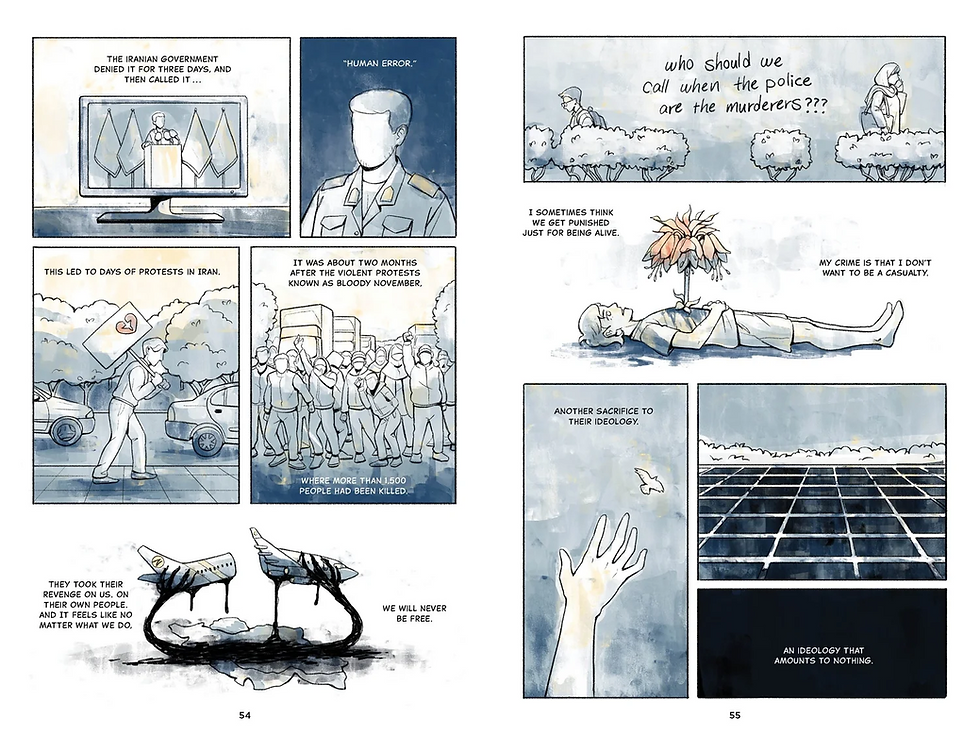
LF: It was sort of surreal. When we began working on the book last fall, we had the aim of publishing it in time for the one-year anniversary of the so-called 12-Day War in June of this year. Of course, with the war in Gaza and Israel attacking Lebanon, Iran was still very much on our minds. And then in January of this year, came the crack-down on protestors in which the Iranian government killed thousands of their own citizens. And the US government began using that as a justification to get start a war. That was when the internet blackouts started. But I was so honoured that the editors trusted me to continue with the book during that time. And recently, I’ve been so glad to have sporadic contact with them again, and to know that as of now, everyone who worked on the book is still safe.
CBY: That is a monumental relief, and I am glad we're not breaking any tragic news with this interview. “Memento Mori” contends with living life structured around the spectre of death in a beautifully rendered manner. “My Dream City” focuses on mourning “what never got to be,” eulogizing the moments rescheduled – the actions not taken – because of the disruption caused by war. “Stay Alive” chronicles the disruption and the detours created by war. All these creators are reacting with different negative emotions; what sort of reactions have you received from those whom you’ve shared this title with since you prepared the anthology for publication?
LF: The reaction has been overwhelmingly positive. It seems that people have been craving some sort of human perspective on this war, and the book recently received a starred review from Booklist, the book review journal of the American Library Association. And the School Library Journal wrote, “These are nuanced, engaging stories which deserve full attention, and they are incredibly important to consult as the cycle of violence repeats yet again.” So, I am very encouraged to think that people will have access to these stories in libraries across the country.
CBY: Libraries are the vanguard of free though, so it heartening to know the anthology will find its home on shelves nationally. “A Safe Place” examines the invisible war no one can escape, being trapped within structures, unable to solve problems. “Under the Same Roof” examines the increasing pressure faced by families as support structures are pushed to their limits. “Until After the War” deals with displacement in life, and feeling ‘like something’s going to happen again’ (which was prescient, as this year, the war has resumed, lasting far longer than twelve days). What should we expect next from Street Noise Books to meet the moment now upon us?
LF: Street Noise is always looking at what is happening around us and trying to shine a light on things that aren’t being focused on enough. We have a new book coming from Palestinian cartoonist, Mohammad Sabaaneh called Welcome to Hell: From the West Bank to Gaza, and then in the fall we have an amazing work of graphic nonfiction called Soft Targets: Guns in America and the Kids Caught in the Crossfire by a former NPR journalist, Camila Kerwin.
CBY: I await reply from Mohammad on Welcome to Hell - it's another indispensable, eye-opening exploration of the unnecessary cruelty being carried out by Israeli forces. I hope Camila will also stop by the Yeti Cave to discuss the national gun violence issues closer to her publication date. “Tehran Apocalypse” brings the world crashing down in a manner that erodes all the little ways the author has worked to build themselves up. Concluding with “The Fireworks,” uncertainty is masked by putting up a veil of security that simply cannot hold in the face of continual threat. In turnabout from last year’s 12 Days War, at a national level, Iran now holds a much stronger strategic position by exercising its control on the Strait of Hormuz (and by extension, a significant chunk of the global fossil fuel and downstream commodities market). How has the sentiment evolved within The Cartoonist Collective of Tehran, and what further steps can artists take in breaking the lethal chokehold held on the global discourse by military powers forcing the world onto a worse trajectory?
LF: Since the current war began, I’ve only been in contact with the two editors, not with the rest of the artists of the collective. What I hear from the editors lately is that they are exhausted by the aggressive posturing and the repeated threat of annihilation and subsequent ceasefires. They are frightened and horrified by the destruction they have witnessed. And they are finding it hard to find any hope to cling to.

CBY: I have been discussing with Iranian colleagues how great the sense of intractable despair remains, generation after generation, as Iran is unable to find a clear route towards greater freedom from both internal and international oppression and violence. Though we have made it to the end without solving the geopolitical quagmire underway, I hope we've provided some useful reflections for our readers who may not be engaged with this situation beyond media soundbites. As is customary here, we like to offer guests an opportunity to make mention of any unrelated work they’ve seen lately, including comics, films, music, literature, etc., that has been providing you with inspiration lately. What else should our audience be aware of that may not be on their radar?
LF: Since I started working on this book, I’ve watched some Iranian movies on the Criterion Collection. Two that I recommend are from director Jafar Panahi; The White Balloon and 3 Faces. They were both fascinating and I’d like to watch more. And I’ve been reading a wonderful YA memoir by a brilliant Iranian-American friend of mine, Daniel Nayeri, called Everything Sad is Untrue. Also, Graphic Mundi has published a fascinating graphic novel translated from the French called Iranian Love Stories which I also recommend.
CBY: Liz, thank you for making time to discuss this critical issue, the added recommendations, and for helping bring what is happening on the ground in Iran to a wider audience. If you have any portfolio, publication, or social media links you’d like to share, now is the time and place.
LF: We have several books by authors from that part of the world. Restless by Joseph Kai is a graphic novel set in Beirut, Lebanon which won a translation prize last year. And we have two powerful graphic novels by the brilliant Palestinian artist, Mohammad Sabaaneh. The first is called Power Born of Dreams: My Story is Palestine, and that book won the Palestine Book Award, and then we have another coming soon called Welcome to Hell: From the West Bank to Gaza. Last year we published an incisive and timely book of essays called Eyes on Gaza: Witnessing Annihilation by Khaled A. Beydoun with art by Mohammad Sabaaneh.
People who are interested in our books should check out our website streetnoisebooks.com and sign up for our monthly newsletter there in order to stay current with our latest news. And I encourage folks to follow us on Instagram and TikTok @streetnoisebooks.
Like what you've just read? Help us keep the Yeti Cave warm! Comic Book Yeti has a Patreon page for anyone who wants to contribute: https://www.patreon.com/comicbookyeti


