


MARK MOSEDALE and SI SMITH Clock in with GIGS

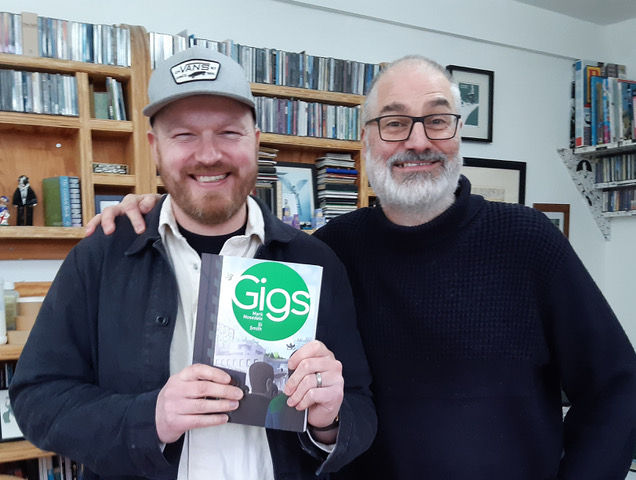
Interviews Editor, Andrew Irvin, is joined by Mark Mosedale and Si Smith to discuss their detailed dive into the near future of Gigs, out now through Top Shelf Productions.
COMIC BOOK YETI: Mark and Si, it’s a pleasure to have you into the Yeti Cave! I’m glad I’ve finally had a chance to give Gigs a read. How have you both found the response thus far?
SI SMITH: Hi Andrew, thanks for having us!
MARK MOSEDALE: What Si said! Good to be here.

SS: The response to Gigs has been great, and that’s been very gratifying. Whilst we were making the book – a lengthy process – we always felt like we were making something worthwhile, that it had heart and integrity, but until it’s out there and people get to actually read it, you can never really be sure about that. So there’s some relief in there too!
MM: We put so much into it, and it’s really exciting to see people responding to all that effort and thought. When you read reviews from people who’ve picked up on these little details or approaches we took – things that, for all we knew, people could entirely miss – it fills you with all the good chemicals.
SS: A few readers have got things from the book that I’d not really been consciously aware of, but which make total sense – I’ve especially loved that.
CBY: External recognition of choices you don't even realize you are making in-process can be both enlightening and delightful, relating to your work through someone else's perspective. From my understanding, you both started collaborating around seven years ago; can you share a bit about how you initially were introduced to each other and how your collaborative relationship has evolved over the course of producing Gigs? A lot has happened since 2019, so what activities beyond this project have impacted your lives in meaningful ways and shaped its trajectory?
SS: I first met Mark when he was working at OK Comics here in Leeds (where we both live). At some point I joined the (Comic) Book Group that he coordinated, and I got to know him a bit better through that. I was at a point in my comic-making where I was looking to work with a writer, and I knew that Mark wrote, so I took a punt, asked him if he was interested in making a comic together, and it all started from there.
MM: I’d been wanting to make comics for ages, but the problem with being a comics writer is finding someone to work with. So, I’d just been sort of twiddling my thumbs. When Si messaged me, I bit his hand off.
SS: Given that neither of us had worked together or made anything as ambitious or as lengthy as Gigs, I feel like our collaboration has worked way better than either of us had any right to expect. To be honest, I think that a lot of that is down to Mark’s personality – he’s a very stable character and, as it turns out, a properly good writer (my punt was a good one). That said, I’m possibly not the easiest person to work with, so Mark may have a different take on things.
Obviously we were working on the book during the Covid pandemic, but having Gigs to focus on during the lockdown was actually great for me.

MM: A lot of what’s happened over the years since that first meeting has worked its way into Gigs – the rise of generative AI, Covid, the growing appropriation of our collective creativity by corporate interests, and on a personal level I did a 100-mile ultra-marathon, then quickly went from being someone who has time for that sort of thing to being a father – it’s all in there! And yet, the structure we came up with back in 2019 hasn’t changed. It was just sat there, waiting to receive all this material.
CBY: The characters definitely feel forged from personal experience, and the long-distance running had me wondering, as I would think many writers might consider it a bit too extreme a component of the plot unless they'd personally undertaken it and knew it to be within the realm of the achievable. You’ve both provided dedications and acknowledgements to bookend this publication, crediting Chris Staros as Editor-in-Chief over at Top Shelf Productions. First, could you tell us a bit about how you ended up publishing through Top Shelf, and more broadly regarding your comics careers, what other people might you like to make mention of who had formative roles in helping you find your way towards comics as a medium?
MM: The big one for me is Jared at OK Comics, who’s one of my best mates. We met when he gave me a job at OK 20 years ago, and it flung the doors of my understanding of comics wide open. Up until then I was a superhero and Vertigo guy, but working and then shopping at OK really opened up the depth and breadth of the medium for me.
Chris, obviously, has been awesome and a joy to work with, though the story of how we met him really belongs to Si.
More recently, Kieron Gillen has been helpful, and since we finished making Gigs I’ve met Shelly Bond and wished I met her five or 10 years earlier. Honestly, there’s plenty of advice on the craft of comics out there, but finding guidance on navigating the industry and building a career is much harder – Shelly’s been great on that front.
SS: Chris is great. Everyone that we have spoken to about him has nothing but good things to say.
A lot of the books on my shelves are Top Shelf books and some of the artists that I most admire started out with Chris and Top Shelf; Liz Prince, Jeffrey Brown, Craig Thompson. So back in 2016 I’d sent Chris a copy of a comic that I’d made, not with any real expectation that he’d publish it, more as a thank you for the stuff that I’d taken so much inspiration from. I sent copies to a few other folks too, but Chris in particular replied with a lovely, encouraging message, saying that he’d be interested to see any future work that I was making, so pitching him was a natural move.
CBY: That sort of follow-through on expressed interest is never a guarantee, so it's a testament to Chris's sincere interest in your work that it came to fruition in publication through Top Shelf Productions. In five pages of exterior scenes at the start of Gigs, you lay out very quickly the scope of the dystopia your characters inhabit. The news bulletins provide rapid acclimation through sound bites of the state of the world. Everything plausible, much of it awful; what pieces of news from our current affairs did you latch onto for inspiration, and how does the imagined future you’ve created reflect the pressures you both witness in the world around you?
MM: There’s a strain of bleak-future world building that’s pretty tolerable; your Mad Maxes or Walking Deads, because while you might wince for the characters in them, they’re such a stretch from ours that they’re not that scary. For me, the worlds that really get under your skin are the ones that are chillingly plausible – I always think of the near-future section of David Mitchell’s Bone Clocks, or The Hard Tomorrow by Eleanor Davis or the recent work of M. John Harrison.

It’s not hard to think that from the point of, say, 2006, we’re living in one of those futures now. Capitalism’s gone so far it feels like a Bill Hicks punchline, our tech barons sound like they’ve wandered out of a Joseph Heller novel, totalitarianism’s on the rise, bees are on the endangered list, we’re in the early stages of climate collapse… I won’t keep going, or I’ll just have to go lie in bed and stare at the wall. The point being, the headlines in Ivy’s walking sequence could be a random sample from 2026, never mind 2046, but I hope that we moved them on – or reframed them – just enough to knock a few people out of reality for a moment to help them grapple with the possibility we might already be living in the bad place.
CBY: Yeah, by highlighting the dystopian immediacy, hopefully it will help people reflect on the need for blueprints toward a better future. Beyond the verbal cues about the world you’ve created, there are so many visual nods that appear throughout scenes, silently revealing character traits and serving as effective exposition. How much of what we see in-panel was explicitly scripted, Mark, and Si, how many Easter eggs did you add on top of what Mark sent your way?
MM: Working with Si makes exposing character really easy. Instead of always layering in dialogue cues or describing a facial expression, I’d be able to write something like ‘Syd is visibly pained by Ivy’s words, her face looks like it’s caving in on itself’, and Si would just deliver on it. His character work is so soulful (I think!) thanks to years of sketching the people around him that getting our characters’ inner lives onto the page was easy. At least for me, given that I didn’t have to actually draw it.
In terms of those really specific worldbuilding touches, it varied a bit. We went back and forth a lot on, for example, what books Ivy is reading, and I provided reference on things like running kit and the nerdier stuff in Steve from IT’s flat, but then you get into Syd’s room and I just wrote something like, ‘it’s full of music memorabilia’ and Si just absolutely went to town. (There’s something to be said for knowing what sort of stuff your artist is going to go bananas on).
SS: Ha! Well, yeah. One of the great things about working with Mark is that he’s been very happy for me to take his script and run with it, so even when a panel or a page was quite tightly defined, there was always space for me to layer in a load of additional relevant stuff. And because we’d always wanted the world of Gigs to feel dense and lived-in, it made sense for me to throw all that stuff at it.

As a result there are loads of Easter-eggy things in there – honestly, some of them only make sense to me and were only included for my own amusement (e.g. - references to my kids, my childhood family telephone number) – and the members of our comic book group are all referenced in recurring graffiti. There’s at least one Bladerunner reference tucked away in there, and then there’s a shed-load of visual worldbuilding stuff like the posters and records in Syd’s room. One of the nice things for me in seeing the book now is that I regularly spot stuff that I’d completely forgotten I’d put in there.
MM: I think there’s stuff in there I still haven’t seen.
SS: There definitely is…
CBY: It adds so much density to the page and provides additional layers of engagement I very much appreciated as I was reading. I especially liked the nod toward the first Sex Pistols gig, the relevance of which may have been best explored in David Nolan’s I Swear I was There. I’ve always considered the Sex Pistols as basically noisy mannequins for Vivienne Westwood designs, and I think you positioned them appropriately, with X-Ray Spex getting more favorable real estate on the page. What other musicians did you have on the roster to feature that didn’t make it into the dialogue or scenery?
SS: Yeah, there was always something cynical about the Sex Pistols and the hype around them – the Bill Grundy interview and all that tabloid-baiting sensationalism– that’s Malcolm McLaren’s input, I guess… But I do love the mythology of that first Manchester Sex Pistols gig – I’ve not read Nolan’s book, but I know a lot of the stories.
Meanwhile, Viv Albertine’s book Clothes, Clothes, Clothes. Music, Music, Music. Boys, Boys, Boys is brilliant and is well worth a read (in Gigs, our protagonist Ivy gets a copy from the librarian, and Syd has one too) – in that book you get to see how much harder it was for The Slits and X-Ray Spex than for the blokes in the punk movement. And actually, when we started to think about it, a lot of Polly Styrene’s lyrics proved to be very appropriate for the world that we were creating Gigs.
The narrative around that legendary Pistols Gig also speaks to Syd’s character in the book – to a greater or lesser extent we’re all unreliable narrators of our own stories, and she’s no different, using music and her fandom to curate a very particular version of herself and her history.
If we’d had the space and the time, I’d have liked to have explored her record collection in a little more depth. There are nods in the book to her life after punk where she goes all rude-girl with 2Tone and the whole ska thing, and she also clearly had a Riot Grrl phase. I think she’d have loved Delta 5 and some of those post-punk bands too.
Then with some of the ephemera in her room – LP’s, flyers and posters, photos, etc. – there’s a suggestion that she was a bit of an older raver in the 90s… Plenty of little obscure details for readers to go find.
It would have been nice if we could have given her a Sarah Records fixation (but maybe I’m just projecting now!)

MM: I considered going deeper into Syd’s hip hop phase, and we do nod to it a bit, but I just didn’t feel qualified to write that in the end, and we had plenty of material to go at from her other phases. It felt appropriate to transfer my lack of credibility in that arena onto Syd. Where my credibility broke down on punk, though, I was able to lean on Si, who’s got a few years on me and has a more direct connection to that era of music.
CBY: Thanks for unpacking how the "write what you know" maxim played out in the context of Gigs. There’s a great line about persisting by choosing to “do the next right thing,” and resisting capitulation to systems of oppression. You take the opportunity to introduce a solarpunk response to a societal paradigm built on the procession of integrating cyberpunk concepts further into techno-authoritarian systems, which is something I’ve been focusing upon in my research. Touching upon seasteading, guerrilla gardening, non-hierarchical community management systems, and other elements of decentralized resistance, you both present a layered metaphor for mainstreaming autonomy from oppressive structures with the conclusion - how would you both like to see a better future brought into being in our world after researching the societal features you’ve included in the near-future world of Gigs?
SS: UBI would be great, but obviously not the version that we’ve envisaged in the book. If AI continues to hollow out the job market people simply won’t have the cash to spend on the products that companies are making, so governments are going to have to find a way to step in and square that circle somehow.
MM: Even if they can’t be arsed to do it on our behalf.
SS: But to be honest, I think that it’s really hard to see a way that things improve from where we find ourselves now. So much power has been ceded to terrible people who have made themselves determinedly unaccountable; billionaires and late-stage capitalism are a really bad combination. But in Gigs we were determined to thread some hope through the bleakness. Whilst we’re probably beyond the point where localism and eco-positive personal choices will ever be enough to save the planet, those kind of small scale, DIY acts of resistance, belief in kindness and the common good seem pretty vital now. Otherwise, you’d just give up. (Blimey, that’s grim. Sorry…)
MM: I’m not quite as pessimistic as Si, but I’d be lying if I said I had a powerful belief in any particular idea or system for getting us out of the mess that is 2026. I do think grassroots initiatives and activism are important, though. We’re not going to solve our ecological problems with guerilla gardening, or our extractive capitalism problems with local co-ops, but it seems pretty clear that our politicians and financial ruling class aren’t going to get much done without some bottom-up leadership. I think anything that engages people in making a positive difference in their communities and democracies is good for the whole system. And I think that more concrete examples of this sort of thing, like citizens’ assemblies, show some promise.
I would add, too, that getting a couple of hedgehogs through a drought-ridden summer by putting out water, or helping to pay a local person’s wage by shopping local, isn’t nothing, even if it’s not enough to solve our bigger problems. Making the world a little bit better is always a win.
CBY: Every gesture of goodwill and kindness we can offer within our control aggregates towards a better overall world to exist in for not only people, but other species as well, which I'm glad you mentioned. Si, you’ve landed on this distinct visual approach, where the characters are stylized and don’t conform to standard anatomy, but the architectural and natural elements are largely true-to-life and highly detailed. Si, I know you mentioned Eleanor Davis’s The Hard Tomorrow and many other influences in your AIPT interview. What sort of conversations did you two have over the visual development process about character design, landing on the right appearance for everyone, and then committing to the incredibly detailed scenery throughout? Mark, what guidance did you provide as a writer, and Si, what techniques and tools did you utilize to achieve the look of Gigs?

MM: My biggest design note was ‘today, but 20% worse’ (at least, I think that was me - at this point it’s hard to be sure!). I wanted the world of Gigs to be very relatable and concrete - no floating things with glowing bits underneath. And it needed to feel properly lived in. Part of the inspiration for that (at least on my end) was Star Wars; everything needed to be worn and foxed to make it immersive.
Early on we talked about the world of Gigs being visibly stratified, with all the gig workers living at ground level and the few people with money occupying the higher levels of the city’s buildings. You can still see a bit of that in the design, but it fell to the wayside as a narrative world building element. It felt too ‘big’ and top-down to be something really encoded into how the Gigs future works. Instead, it’s just something that’s gently present, a natural outcome of people with money wanting to keep their distance from people without it in a dense urban area.
SS: Yeah, "20% worse" was part of Mark’s initial pitch to me, I remember that! And to Star Wars, I’m going to add Bladerunner. I grew up watching things like Logan’s Run and Buck Rogers where the world is all sleek and shiny, so seeing grittier, grimy visions of Space and The Future had a massive impact.
Anyway, in terms of my process… Gigs was largely penciled (using actual 2B pencils on cartridge paper) and then lettered, inked and coloured in Photoshop.

I’m a messy, inefficient worker (see my earlier comment about not being easy to work with) and there are a ridiculous number of layers of artwork in each page. It’s very labour-intensive and I wouldn’t advocate working this way to anyone else; it’s just how I have ended up doing it. Some of the more complex pages in Gigs have more than a hundred layers of artwork in them, and each page took on average about three days to make (I work quite long hours too).
In my defence though, we wanted the urban environment in Gigs to feel claustrophobic and weathered (that was one of the first things that Mark specified actually – this book needed to have a lot of weather in it - see Bladerunner) and I think that we achieved that. The location has ended up like an additional character in the book.
Then of course, once Chris had greenlit this project, I was very much of the mindset that this might be my one and only shot at making something this ambitious and lengthy. So I was determined to give it everything, to cut no corners, to absolutely throw the kitchen sink at it.
I took a lot of reference photos to help in dreaming up the urban environments in Gigs – so the more futuristic architecture sits among current buildings, giving the place some roots and some history. I drew a lot of inspiration from the work of Liam Young, a speculative architect who I’d recommend folk go and look up – he’s a really interesting artist.
In terms of character design, I take the bus into town quite often, and use my time on there to draw the people that I observe (I had an exhibition of some of those drawings a few years back). Most of the incidental characters in the book were sketched on those journeys.

CBY: The evolution of the cast from lived experience is a very grounded way to approach getting characters who ring true without applying techniques of formal realism, for sure. It was also very astute framing Syd’s role in game design as the bridging point between art and its co-opting by corporate interests. With a character rooted almost entirely in tropes of alterity creating a tool that leads to greater surveillance and cultural control through gamification of the labour economy, you have created an avatar for the subsuming of creative industries through technology which has been playing out over the last forty years. As creative practitioners who understand freelancing, what sort of insights would you like to share that build upon the points raised in Gigs; if you sent a copy of this graphic novel to your mayor, your representative Member of Parliament, or your Prime Minister, what would you write in the note you send along with it?

MM: You know, I actually did give a copy of Gigs to my MP, and another for him to give to our new Prime Minister, Andy Burnham, if he got a chance. I met the mayor of Melbourne in a pub and gave him a copy, too. I wish I’d written a note in them. Though, hopefully, the book says everything I’d want to say.
In a nutshell, though, I’d say that politicians need to start taking human art seriously as an end in itself (I can’t believe I just had to write ‘human’ art). Even more so in an age when all these forces are trying to co-opt and ensloppify creativity. If the tech companies want to leach the blood out of human experience, then the way to resist that is to double down on the things that most make us human. Art is one of those things. It’s important, and it needs to be a priority.
CBY: Yeah, I've been noting which people are process and production-oriented, and those who are product/consumption-oriented, and where the dividing line exists between philosophies around creativity and the conflict that has arisen cross-culturally. Given the timeline involved in bringing Gigs together, I presume you both have other projects in various earlier stages of development. Can we expect a return to the world of Gigs, or do you both have other unrelated projects in the works you can tell our readers a bit about now that Gigs is on retailer shelves?

SS: We do have a little document full of additional ideas for Gigs vol 2, if that ever came around, including some stories that didn’t quite make the cut for Gigs, or weren’t evolved enough at that point; some ideas that have popped up since we handed the project in to Top Shelf, and some other random thoughts that may or may not warrant further development. So we have plenty of stuff to go at if the opportunity arises to revisit that world (and of course it’d be nice to see what Ivy’s up to now). Meanwhile, I’m also busy working on a graphic novel for Top Shelf with another writer, but it’s still very early days on that – it won’t be done for a couple of years yet (again, the inefficiency thing!)
MM: Si and I have a story in Shelly Bond’s upcoming subCULTURE anthology, which I won’t say anything about except that it does touch on some of our themes from Gigs from a very different direction.
Beyond that, I’m working on something with another artist that builds on some of the ideas in Gigs in a way that’s science-fictional in a more wildly speculative way. It’ll have more explosions in it, too. I’m hoping that it can be a series – I’d love to roll up my sleeves and get into the trenches of monthly comics.

CBY: Readers will be the better for having all of these projects available, no doubt. As usual, here at the end we provide a moment for guests to share inspirations unrelated to their own work. Clearly music was a huge inspiration on Gigs, so what other comics, films, music, literature, and other endeavours should our readers check out?
MM: The photography of Tish Murtha is great. She did a lot of documentary photography capturing youth unemployment in Newcastle (UK) in the 1980s that really aligns with what we were shooting for with Gigs.
Comics-wise, Tom Humberstone just released a great non-fiction comic on a subject that’s very close to our hearts called Just Work. It’s about (you guessed it) the gig economy, though it comes at it from a very different angle. If I were a retailer, I might be offering Just Work and Gigs as a bundle.

SS: Well again, that Viv Albertine book is really great – I can’t recommend that highly enough. Not just for the punk history, but it’s also got lots of insightful things to say about being an artist, motherhood, illness and a ton of other stuff.
Music-wise, Skepwax is a fantastic label, with strong connections back to the Sarah Records bands that I have always loved, so you should definitely check them out – The Cords and Tulpa are two bands on their roster that I am currently very much into (and Rob Pursey from the label gave us a very lovely pull quote for Gigs, too).
Here’s my film recommendation – The Ballad of Wallis Island. If you don’t know about it, don’t google it in advance, just give it a watch.
CBY: Great stuff - most of which I haven't caught yet. Mark and Si, thanks for stopping by! If you have further portfolio, publication, and social media links to share, now is the time and place to include them.
MM: I’m on Instagram as @thatmarkperson and BlueSky as @markmosedale.bsky.social.
Thanks for such a thoughtful set of questions, Andrew. I really appreciate the time and thought you’ve put into them.
SS: I’m on Insta @curmudgeonly_si and there’s a Gigs IG too - that’s @gigsgraphicnovel. And I have a little drawing blog which I ought to update more often - https://sidestreetsthatyouslipdown.blogspot.com
Like what you've just read? Help us keep the Yeti Cave warm! Comic Book Yeti has a Patreon page for anyone who wants to contribute: https://www.patreon.com/comicbookyeti


