


JULES SCHEELE Brings Woolf's ORLANDO into Full Color

Interviews Editor, Andrew Irvin, welcomes Jules Scheele, the live scribe and creator who has given us the graphic novelization of Virginia Woolf's Orlando from Avery Hill Publishing.
COMIC BOOK YETI: Jules, welcome to the Yeti Cave! How are things going up in Scotland? I’ve still never been, but if I make it to the U.K. again in the future, it will certainly involve a visit to Edinburgh and Glasgow.
JULES SCHEELE: Hi, and thank you so much for having me! Scotland is grand – the heatwave sure is getting to everyone, but I’m very glad we’re not having South England temperatures up here. I’m even welcoming the still frequent rain!
CBY: Europe's heat wave is an alarming reminder of the mounting extremes we're facing. Since it's cool enough in Scotland to proceed, it would be great to start with an overview of how Orlando found its way into your portfolio. What were your earliest experiences with comics, how did you first come to appreciate Virginia Woolf, and when did the idea to create this adaptation initially arise?

JS: Comics have been a big part of my life since I was a little kid - I learned to read ahead of school with my brother’s old Asterix, Tintin and Lucky Luke comics, and I read a lot of the Carl Barks Disney comics all throughout my childhood, too. You can’t get the latter in the UK because of muddled licensing laws, but in mainland Europe, you could buy thick volumes of old Disney comic reprints for almost nothing at every train station or newsagents. As a teenager, I then got into manga in a big way, then webcomics, then indie comics – alt punky/gothy stuff like Tank Girl and Gloomcookie, then the more slice-of-life autobio fare coming out of Canada and the States. I always wanted to make comics, but never really got my act together until I started working at a major mainstream comics retail chain after university. Through that, I started meeting other people who would go to comics and zine fairs and conventions and it opened up a whole world of possibility. I really loved the DIY scene and was making small press work almost exclusively for ten years before I got published, which was a great time for experimentation and learning.
Regarding Orlando and Virginia Woolf, I read both Mrs Dalloway and Orlando for the first time when I was about 17 years old. I loved both, but I felt like there was a barrier blocking my appreciation for Orlando back then – I think it was because I was very avoidant about my own gender identity for a very long time. I always wanted to watch the Sally Potter film, for example, but just never quite got around to it until after I transitioned, and then it all clicked together in my mind. I don’t think I was ready to really grapple with the work until then. Funnily enough, it wasn’t too long after I finally watched the film that Ricky from Avery Hill approached me with the idea of doing a graphic novel adaptation of Orlando – the book had just entered into the public domain and he immediately thought of me, which was very flattering and exciting. I’d done work with Ricky before, on his own passion project comic series, Metroland.
I had only worked on graphic books with other writers at that point, mainly non-fiction/academic work, and I really wanted to get my act together for an original graphic novel. Even after I started feeling much more confident and ready to develop my own voice after transitioning, I was still unsure about the kind of story I wanted to tell. When Orlando came along, I thought doing an adaptation of something I had so many thoughts on, with the freedom of putting my own spin on it, was a great opportunity to see what I was capable of.

CBY: Reading through your prior work, you mention growing up across a variety of countries. I think about this often as I raise my kids in a country outside their citizenship, and what sort of shift in understanding of the world it creates in them. How did living internationally over the course of your childhood shape your perspective, particularly when it comes to existing in the spaces between easy characterization? How may recognition of intersectionality that you can’t escape when living cross-culturally contribute toward your examination of gender and sexuality in your career?
JS: This is such an interesting question because it’s something I really don’t think about that much day-to-day anymore, but the impact it had on me as a person was obviously huge. Like with anything, there are a lot of grey areas to it. Ultimately, I think any upbringing where you come in frequent contact with people who don’t look like you and have different cultural touchstones and ways of life is beneficial to building understanding and empathy, and empathy is, in my opinion, the most important thing for creativity and storytelling. However, I don’t necessarily think you need to move around as much as I did as a kid to do so.
As a white European kid whose father worked in foreign aid, I obviously also lived in very privileged bubbles. Thankfully my parents were never completely taken in by “ex-pat” communities and often found them ignorant and cringey. I believe my father was successful at his job because he liked to approach people on a very personal level, rather than a hierarchical one, which meant he didn’t talk down to people and was able to listen and work without being prescriptive or overly attached to the Western Way of Doing Things. He taught me a lot about kindness and interrogating expectations – he always was so delighted to learn new things and consider different perspectives. He had a tough upbringing and he could be that kind of 60s socialist who was still culturally conservative in some regards, but he was always open to different opinions as long as you could hold your own in a conversation. This could be really tough on me in its own way, but at least it always kept me thinking about things more deeply than I probably would have done otherwise. I think with different parents, my experiences living abroad could have been just as limiting as staying in the same place every day. I’ve seen other international kids come out of these experiences really conservative, and I think it’s because at home they were already instilled with the belief that they were better than the people in the countries they lived in. They didn’t engage, and whenever they got pushback for this, they got defensive and went further inwards, and I just never wanted to be a person like that.
I still grew up with a lot of cultural stereotypes about gender and sexuality deeply embedded in me, and I had to work to unlearn that. There were a lot of things I was very open about from a young age, but for other people, not myself. One downside from moving around so much is that I was the perpetual new kid, and an awkward and neurodivergent one at that, so being different and standing out wasn’t a choice for me when I was younger. It felt more like something that was completely out of my control, and it took a lot of time for me to learn to override that old fear.
CBY: Oh, I have very similar feelings about the expat community (as someone who emigrated and never quite bought into it); seeing people holed up in gated communities with kids in private international schools, if they don't make an extraordinary effort to dispel classism and engage with other perspectives, it becomes another stratifying, isolating way of life. Now, we’re coming up on the centennial of Woolf’s initial publication of Orlando. I believe my introduction to it came with 1992’s adaptation by Sally Potter starring Tilda Swinton, which we watched in my English literature class in high school. I have never done a close reading of the text, but I enjoyed your rendition immensely. What are your favorite aspects of various other adaptations that you drew upon for your own iteration, and what choices did you make to elevate parts of Woolf’s original text for the readers?

JS: Looking into the adaptations was a really fascinating part of my research and prep for the book! Orlando, the original novel, still feels so radical today because of the way it engages with gender, sexuality, and identity – non-prescriptive, dismissive of binaries and black-and-white thinking, surprising, expansive, deeply understanding of people’s flaws and foibles, and all of it with a strong sense of magic and poetry. I think it really gives people permission to adapt it in interesting and creative ways.
I always enjoyed the way people utilise the unreliable narrative voice guiding you through the book, especially when adapting it for different mediums – for example, in Sally Potter’s film it’s Orlando breaking the fourth wall and addressing the audience. In Neil Bartlett’s recent play, which seems to be one of the more straightforward adaptations, there is a diverse cast of multiple Virginia Woolfs narrating along from the sides of the stage. There’s an amazing art film from 1981 by the German filmmaker Ulrike Ottinger called Freak Orlando (it’s also partially based on Tod Browning’s Freaks), which I recently described as a queer Holy Mountain. Paul B. Preciado’s documentary Orlando: My Political Biography stars 26 contemporary trans and non-binary people, aged 8-70, as Orlando and themselves, reading passages from the book and telling you about their own lives.
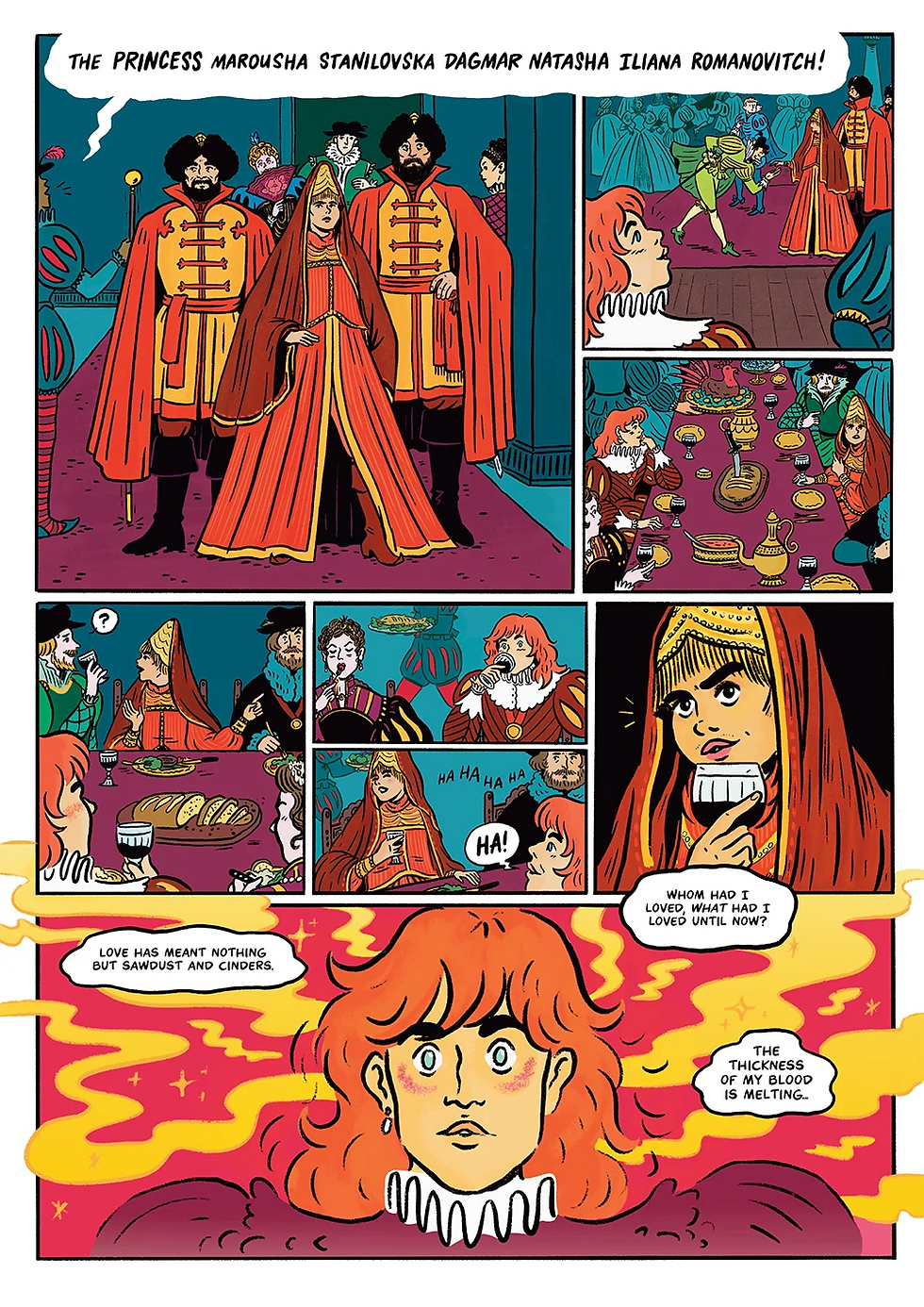
I almost immediately got excited by the idea of enlisting the other characters in the book, from the real to the fantastical, to partly take over the narration. It opened up many interesting possibilities: firstly, thinking about how queerness is often observed from the outside, and discussed and speculated about across popular media without our actual input as queer people.
Secondly, I thought it could give some narrative agency to people from a different class and circumstance to Orlando, meaning we also hear from the servants and sex workers who are prominently featured in the book - as well as characters in the Constantinople chapter. As progressive as the book is (and even as an intended satire about Empire), it hasn’t dated quite so well in other aspects, especially in its Orientalism.
Thirdly, as birds are a running visual theme throughout the book, they get to put their two cents in as well. This is also a reference to Virginia Woolf believing late in her life that the birds were singing to her in Greek. I also enjoyed weaving in more contemporary references to queer personalities which I think embody the spirit of Orlando, to pull the book into the present and highlight how impactful it can still be in the future.
CBY: You definitely had other voices chiming in, effectively drawing upon their presence in the scene, and the non-human agency expressed through birdthought is a playful way to pay homage to Woolf's affinity. It also brings to mind the Bowerbird Collective, which you might enjoy, as it explores the lyrical and tonal exploration of birds that has inspired songs globally, shared between our species. Beyond Woolf, what feminist authors and other creators from the LGBTQ+ community would you recommend to our readers? Beyond your acknowledgements at the close – including recognition of Dickon Edwards, who wrote your foreword – through their work or through their role in your life over the course of your life and career that you’d like to mention here?
JS: As you mentioned Dickon, I want to recommend his diaries which are just being collected – so far volume one is out, called Diaries at the Centre of the Earth, which runs from 1997 to 2007. Dickon’s diary is the UK’s longest running web diary and will give you an incredible and entertaining insight into queer London life and the indie pop scene from that time. Other queer diarists I love are Lou Sullivan, a gay trans man who fought for his transition in the 70s and 80s and was instrumental in our modern understanding of gender being separate from sexuality – his collected diaries came out under the name We Both Laughed in Pleasure and it was a really important book for me early transition. Then of course there’s In The Shadow of the American Dream, David Wojnarowicz’ diaries, which takes us from his growing up to his life as an artist, to his AIDS activism and eventual death. Audre Lorde’s Zami: A New Spelling of My Name, a book she called a “biomythography” also left a huge impression on me. Leslie Feinberg’s Stone Butch Blues is a must for defying easy classification along the lines of gender and sexuality. In a more academic direction, I would recommend Julia Serano’s Whipping Girl, a seminal work that makes the case for transgender activism being an important part of the feminist movement.
CBY: Thanks for sharing! I know the Audre Lorde book and Stone Butch Blues is on my radar, but the rest are all new to me, so hopefully our readers appreciate the added selection for their reading lists. I was speaking with Virginia Haussegger about her recent book, Unfinished Revolution: The Feminist Fightback, and I asked her what sort of male writers have put in the work to be worthwhile feminist authors. As I try to write beyond my own experience; empathizing and embodying other ways of thinking, who do you think best embodies writing beyond their own perspective (particularly those authors who are able to both gaze beyond privilege and cut through their intersectional limitations to deliver honest and convincing voicing)?
JS: I’m finding it very difficult to think of someone off the top of my head, maybe because I don’t know if any author can really escape themselves in their writing. I think work that would fit that description is work that relies heavily on research, community input, and sensitivity/cultural readers. I did enjoy the latest Alan Hollinghurst book, Our Evenings, which I think is the first one of his with a non-white protagonist, and seems to have gotten a good reception generally. He doesn’t stray much from the usual themes of his novels and to me seems to be a deeply observant and well-considered writer, so I think working within his limitations and expanding the point of view within them worked. I would love to hear other perspectives on this, however!

CBY: Now it's a question I'll continue to raise, and hopefully we get a good list together of writers whom others find especially capable at stepping outside themselves in their voicing. Regarding your visual style, you’ve delivered a boldly inked, vividly colored graphic novel. Can you share a bit about your tools and techniques? From the textures, it looks digitally inked and colored, but particularly as you’ve completed every aspect of this title, what does your process look like from starting sketches to finished pages?
JS: It is digitally inked and coloured indeed – I had grand plans for parts of the book to be traditionally inked, but sadly I simply ran out of time for this. I use Procreate on the iPad for sketching, pencilling, and inking as it’s the closest feeling to using traditional media I can get - I use a paper texture screen protector and a special nib from Paperlike, as well as a custom inking brush from True Grit Texture Supplies, which gives me a similar feeling to using the Pentel brush pen on cartridge paper (my go-to pre-iPad). I first do the panel layouts and lettering in Photoshop, then transfer to Procreate for roughs, pencilling, and inking. Then my lovely art assistant Garry Mac did the colour flats for me in Clip Studio, and I finished the colours and shading in Photoshop. I’m hoping to transition away from Adobe to Clip Studio soon for the things Procreate can’t quite handle.
CBY: A very thorough rundown of your illustration process – thanks for letting us take a look under the proverbial hood! There is a quote from Nick Greene, the poet Orlando brings to court, “I can see no good in the present and I have no hope for the future.” In the current zeitgeist, “every accusation being a confession” is a maxim of politics, and the poet proves his exploitative and cynical nature thereafter. There may seem great cause to feel dismal regarding the current state of affairs, with many global leaders openly outing themselves amongst the charlatans and philistines of the world, but what good do you see in the present, and what hope do you have for the future?
JS: It’s difficult at the moment for sure, especially when you are trying to strike a balance between extremes – doomerism on the one side, toxic positivity or complete disengagement on the other – and I don’t know if I have a good answer for this as for many of us, the material realities of encroaching fascism are already causing so much harm. I’m in a position now where I’m a bit older and nicer to myself, I was able to pay for my transition, and though I’m not exactly financially stable as a freelancer or the healthiest person around, I believe I have immense privilege in having my queer family and community to ground me and to fall back on. The good I see in the present is the fierce love I have for the people who are important to me, the admiration for all that they do and work for in their lives, and the different ways we help and support each other. I try to pick that feeling out from the endless news cycle and doomscroll – the stories where people are coming together and organising, either on a bigger scale or just in local grassroots politics or in my neighbourhood.
For me, spending less time online/on social media is always something that makes more space for hope to come in. I won’t allow myself to get manipulated into feeling hopeless and helpless by an algorithm anymore. Having intergenerational friendships is another grounding thing – an older queer person going “it’s your first time, huh,” in a non-dismissive and gently empathetic manner – has helped take me out of total panic mode before. Hope in any time for me is connection to people, and that’s something we have to inconvenience ourselves for, and find reserves of energy for – as communal spaces disappear and AI is being pushed on us. I’m not always good at this myself but all you can do is keep trying and keep engaging, I think. “A voice answering a voice,” as Woolf wrote in Orlando.

CBY: In response, Orlando walks away from the experience with Greene, saying, “Bad, good, or indifferent, I’ll write, from this day forward, to please myself. Fame impedes and constricts, obscurity wraps about a man like a mist. Obscurity is dark, ample, and free, lets the mind take its way unimpeded.” How do you navigate the balance between creating for your own gratification and sense of motivation, and working on commissioned or otherwise paid work? How do you keep your creativity focused and find time to recharge between projects?
JS: Another difficult balance to strike and I often don’t manage to do it! I have had to accept that the time to recharge often just isn’t there – especially with freelancing. I’m so lucky to make a living from illustration, but the flipside to that coin, especially at the moment, is doing more and more work for less and less money and living invoice to invoice and worrying about my livelihood. I haven’t had a break since finishing the book yet, and my upcoming time off is peppered with events I’m doing for Orlando. I just can’t seem to find the time to rest properly. It’s difficult because I love what I do – working on the book alongside other jobs was so stressful, but even through the worst of crunch times I believed in it and loved doing it, and it is massively rewarding to hold that book in my hands.
I think it’s easy at the moment for art generally to get sidelined as unimportant, but I believe in it with all my heart, as I feel it’s always been a lifeline for me through my darkest times - if I can make something that does that for even a few people, that’s the only thing that’s important in the end. That’s not to say I don’t firmly believe in better working conditions for artists – one of the best things I did for my health was joining a union – but when the structures and the funding aren’t there, or are disappearing, like right now, there are so few options and it’s frustrating, and I have to remind myself of that feeling.
What I love about Orlando is that it’s not about becoming a great, or even particularly good artist. It’s about accepting all the different versions and parts of yourself, including your limitations and shortcomings, and moving forward anyway. There’s no ending to Orlando, or a goal to be achieved – the point of it is the questioning, the figuring out. If I think too hard about the impact something I make will have, the end product gets further and further away from me and the reality of the thing. So the focus has to be on the feeling and moving forward, as much as I can manage.
CBY: You also have a variety of non-fiction titles published over the years, including a variety of guides on sexuality, gender, and relationships. What topics would you like to explore in the future in a factual, grounded manner? How does your process for commissioning and creating these works differ from your fiction endeavours?
JS: I am always excited to work on non-fiction and academic projects with writers who are experts in their field – it’s the freelance work I like doing the most. I like collaborating, and I like bringing my skills to another project to make it more accessible for people. I’m generally quite open about topics, but of course once you get hired for a certain type of work people see it as your niche. I would love to work on something about the history of the internet and especially the vibrant landscape of personal websites that used to exist in the early 2000s - they’re like zines, really. I am always interested in anyone who has a niche special interest and is willing to go to extreme lengths learning and educating other people about it.

For my own work, I am actually only interested in fiction at the moment, because I haven’t really written that much of it. I did journal/autobio comics for most of my 20s and some of my 30s, and it’s because I was very intimidated by fiction and what my shortcomings would be as a writer. I liked approaching things from what I thought of as getting down to the truth and reality of the matter, but I feel a bit less sure about this now, as we all write fiction into our own narratives about ourselves. I feel kind of liberated by the idea of not featuring myself in my work. Of course, I will always be IN my work, but I want to experience making something from somebody else’s point of view.
CBY: I think that returns to our point around the narrative as a means of distinguishing our voices, and embodying different perspectives, and your further reflections echo conversations I've had with others on the same era and aspects of the internet. I'm also a staunch advocate for taxing automated internet activity to build a public, ad-free internet that harkens back to the late 1990s/early 2000s, and fellow Yeti Cave guest, Kris DeDecker has some great guidance on what a low-tech internet might look like. As is customary at the end of our interviews, we provide an opportunity for creators to make mention of any unrelated creative work that has been providing inspiration to you lately. What other comics, films, music, art, literature, etc. has caught your attention lately that our readers should check out?
JS: I watched Angels in America (the 2003 television adaptation of the Tony Kushner play) for the first time recently. I was struggling with my mental health for about a year, especially during working on Orlando, and just refused to watch anything “real” that would make me feel things. I just didn’t think I had the capacity, especially not for an eight-hour-long gay play about the HIV crisis, but I was so, so wrong. I found it astounding and hopeful, especially viewing it in this current horrifying landscape. It gave me that feeling of connection I didn’t even know I was missing.
Book-wise, I enjoyed reading The Gilda Stories by Jewelle Gomez – it’s a speculative fiction from 1991 about black lesbian vampires that takes us from the late 1800s all the way into the (now) not-so-distant future, and it makes for an interesting companion piece to the new Interview with the Vampire TV show which I also love.
The last book I read was Tim Curry’s autobiography, Vagabond. Rocky Horror was huge for me as a weird teen who just got access to dial up internet in the early 2000s, and Tim Curry has always been a very private person, so reading his stories from his really interesting life and career was such a joy. He’s such a lovely, gentle narrator, who is still incredibly boundaried over his personal life, but he can also be appropriately catty at just the right times, making it a really entertaining read! And sometimes that’s just what you need.
CBY: Jules, we are glad to have you here, and the referrals are all both illuminating and appreciated! Your adaptation has breathed new life into what has become a classic tale, and hopefully Orlando reaches new audiences, starting with our readers. If there are any portfolio, publication, or social media links you’d like our readers to check out, this is the time to include them!
JS: Thank you so much for your interesting and thoughtful questions! I hope my answers haven’t ended up too long and rambly. If you’re interested in my work, I have most relevant things on my portfolio website at www.julesscheele.com, and I also have a shop there where I sell zines and prints. Otherwise you can find me on Instagram or Bluesky (@julescheele)!
Like what you've just read? Help us keep the Yeti Cave warm! Comic Book Yeti has a Patreon page for anyone who wants to contribute: https://www.patreon.com/comicbookyeti


