


REDBACK marks the comic debut for JOY ROGERS
Ty Whitton sits down with Joy Rogers, writer and publisher behind Redback — a Cold War espionage thriller that she masterfully orchestrates under her own Redback Comics imprint with their second installment on the story on Kickstarter now!
COMIC BOOK YETI: Greetings all, and welcome to the Yeti Cave for an exciting interview with Joy Rogers on their comic book Redback #1! With issue #1, you delivered a sprawling, genre-blending debut, weaving WWII super-soldier mythology, Soviet-era conspiracy, and modern investigative journalism into a single, meticulously crafted package. Redback is as much a statement of craft as it is a story. You are officially an honorary Yeti for this interview! How are you doing and what has been keeping you busy lately?

JOY ROGERS: Thank you so much, and I am very honoured to be an honorary Yeti! Oh gosh, how am I doing – honestly? I’m a combination of excited, terrified and slightly sleep-deprived, which I think means I’m doing something right. Lately, it has been all systems a-go between the Kickstarter preparations for Issue #2 and what I can only describe as an obsessive amount of worldbuilding! Redback is something I want readers to be able to immerse themselves into completely, so I go beyond the actual story of the comics and into the world around it. Though it can be time-consuming, I think it’s important to give readers a proper world of lore and characters to explore and ‘speak to’ how they wish. Issue #1 is really just the front door into the Redback Universe, but you’ll find there is a whole lot of house behind it.
CBY: The title Redback and the name of your imprint are one and the same — Redback Comics. How long has this story been living in your head, and what finally pushed you to get it on the page?

JR: For me, I believe the characters themselves- more so than the story- have lived in me for a lot longer than I can properly remember. It started with Dean Mercer really (our main man), he was the first thing in this world to exist. He was made as a saviour figure; ultimately I realised I was creating him as the hero I needed when I was at my lowest and eventually I thought, "Well, where did he come from? What’s his story? Why is he the way he is and why does he want to save people who otherwise have already given up on themselves?" That train of thought led me to creating Anya (Redback), then Oglevoy and the rest of the world around him.
It was only in the last year and a half that I thought, ‘I need to get these characters out of my head and onto a page,’ because if this story and these characters reached me at my darkest hour, giving me hope and keeping me on my feet to fight another day – then maybe they can do the same for someone else as well. Especially with how dark the world feels right now, I know there will be people out there who feel trapped, or feel like there is no way out of their situation, and if these characters can reach them the way they reached me, then every page is worth it; for at its core Redback became a story about survival, freedom, and finding your voice when the world wants to quash it.
As for naming the imprint Redback Comics – when it came down to it, it just felt right. Redback is my flagship character, this is her story and I wanted to honour that.
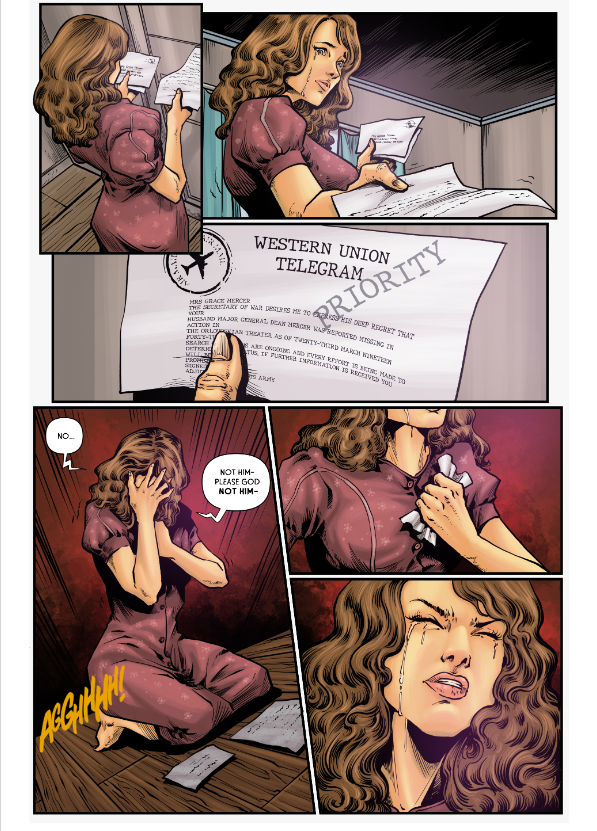
CBY: This first issue opens in 1943, Yonkers, New York with Grace Mercer receiving that devastating Western Union telegram — a very grounded, human moment before the story shifts to a secret lab in the Orlovoskian mountains. What made you want to anchor a super-soldier origin story in the grief of a waiting wife rather than in the action itself?

JR: Well, a very common trope in super soldier or war-set stories is that we open with the action – the battles, the grit, the moment of transformation or capture. I wanted to subvert that completely because I felt the more powerful story was the one happening at home. Grace receiving that telegram is a reality that thousands upon thousands of women and families lived through during WWII, and it’s an angle I think stories of this nature consistently overlook. They show the soldier. They rarely show the ones left behind, still waiting and hoping for their loved ones to come home.
I also wanted the shift from Yonkers to the Oglevoy lab to feel like a physical jolt. One second we see this warm, loving home and then the next you are ripped out of it and thrown into a blacksite; because that is exactly what happened to Dean. He had a life, he had Grace and he had a home – but all of it was taken from him, just like that.
This opener was also inspired by a story from my own family. My great grandfather, John Robson, fought in WWII and was one of the men who parachuted into Arnhem Bridge during operation Market Garden. He was captured as a prisoner of war and taken to work in a German Labour Camp. Hearing this story from my grandmother – not just of his recounted experience but of both hers and her mothers agony in waiting and hoping for his return – that stayed with me. Those untold stories of the people on the other side of the war, the ones on the home front who worried every single day and night, are just as important as the stories of those on the front lines, and that is what I wanted to showcase here. The side we rarely get to see.
CBY: You've invented an entire fictional Soviet state — Orlovoskia — complete with its own Chancellor, a youth propaganda machine, a "Soviet Sweetheart" icon, and intelligence agencies like Oglevoy. How did you build that world, and why go fictional rather than setting it in the real USSR?
JR: I did consider setting it in the real USSR early on, but I felt that ground had been fairly well-covered and that a fictional alternate history world would give me more freedom to say what I wanted to say without the fear of misrepresenting a real country and its history. It also gave me the freedom to push the political themes as far as they needed to go without tip-toeing around real world sensitivity. Because Redback is heavily anti-fascist in nature. It is also anti-propaganda. One of the things I most wanted readers to take from this story is the ability to recognise propaganda when they see it – to see how easily a government can lie to its people, or just how simple it is to manufacture patriotism through fear, fake attacks, and corrupt coups. A fictionalised state gave me the space to show that mechanism clearly without it becoming a commentary on any one specific real world government.
I was also heavily inspired by George Orwell when it came to putting Orlovoskia together; Animal Farm and 1984 in particular. I wanted Orlovoskia to feel totalitarian but with an illusion of freedom that the rest of the world can see right through.

CBY: This issue is subtitled, "A Soldier, A Poet, A Thing." We meet the soldier and get hints at the others. Can you tease what that subtitle means without spoiling too much?
JR: I can actually tell you exactly who is who in the subtitle- it was never meant to be a mystery, more of an introduction to three of our main protagonists.
Dean is the Soldier. That one, as you said, needs no explanation after what we see in Issue #1.
The ‘Poet’ is Elise Wharshamer. She is a journalist who writes the truth with such fearless conviction that it gets her fired (essentially). Not only that but it puts her on the radar of Dean himself – which we will see more of in future issues. Last but certainly not least is the ‘Thing’ which is none other than the deserting scientist, Alexander Kirov. This one is perhaps the most loaded of the three. Kirov himself describes his continued existence as being a, ‘Cog in a much larger machine’. He knows he is expendable and he knows that to Oglevoy he is nothing more than a baited hook in the water, dangled in the hope that Dean Mercer will eventually bite and surface. He is a thing to be used by both sides in various ways… and he is entirely clear-eyed about that.
CBY: Elise Wharshamer feels like the real protagonist of issue #1 – a tenacious investigative journalist tracking a Cold War ghost story. What drew you to centering the narrative on a reporter rather than jumping straight into the super-soldier action?

JR: Originally, Redback was going to be written entirely as a gritty noir journalist story. The whole thing would follow through Elise’s eyes, the reader knowing only what she knows, with the mystery unfolding in real time. I still love that concept and if there was ever a time where I circled back to do an Elise spin-off I would absolutely revisit that format.
But as the story grew, I needed more than one window into it. What I kept though was Elise as the entry point, because having a naturally inquisitive character asking all the right questions to the right people is one of the most organic ways to get information to the reader without it feeling like an info dump. So essentially Elise is the reader. She knows nothing at the start and has to piece it together, and in doing so she carries the audience through the world without them realizing they’re being guided.
So in Issue #1? Yes, she is very much the protagonist; the reader is plonked into this world alongside her and together they begin the journey down the rabbit hole that is Redback and Oglevoy. As the series develops the perspectives will shift and broaden. We will continue to follow Elise’s journey, but we will also begin to see the story unfolding from inside the organisation; through Anya, through Redback, and through Danilovich himself as his own ambitions continue to spiral.
CBY: The anonymous contact, "Your Friend in the Fire" communicates through letters, mysterious packages, and a payphone call — very deliberately lo-fi in a modern Berlin setting. Was that a stylistic choice, a thematic one, or both?
JR: To be fair, it’s a “Happy Accident” as Bob Ross would say. Stylistically, the choices came from my love of those old spy/espionage tropes. That moody, noir atmosphere with the mysterious stranger calling from a payphone, the curly cord and brown envelope slid secretly under a door. Think Agatha Christie's ‘Poirot,’ or strangers on a train – that whole world of secrets and shadows. I find that aesthetic deeply compelling and I wanted some of that old-world charm to bleed into a modern setting. Not quite retro-futurism by any means, but just enough of the old meeting the new to keep the visuals exciting.
In the thematic sense, however, it all meshed together very nicely. In a modern world where digital communication can be tapped, tracked, and listened to without the person on either end ever knowing, going lo-fi is actually the smartest move that could be made in this situation. Letters, payphones, physical packages; these things can be sent and dialed with little to no trace. "The Friend in The Fire" communicates this way because it's the only way to stay undetected, and for someone who has been operating in the shadows for fifty years… that instinct is second nature.
CBY: You wear multiple hats on this book as writer and publisher, with the exception of being the artist. What does your process look like from script to finished page? Do you write full scripts first, or do you plan out the art direction ahead of writing the script?
JR: Since I’m the writer and publisher rather than the artist, my process begins long before a single panel is drawn. Outsourcing freelance artists is expensive (but worth it) and I can’t always have one on-hand immediately. Fortunately, that gives me plenty of time to write. As of right now I have the entirety of Season One written – all ten scripts – so the story is well-ahead of the art.
When it comes to the scripts themselves, I tend to be quite detailed. For more generic panels, I give the artist considerable creative freedom, but for the panels that really drive the story – the ones I can see perfectly clear in my mind – I include as much visual detail as I can, such as reference images, inspiration moodboards, and occasionally when I simply cannot put into words what I mean, I’ll attach a small piece of concept art (by which I mean stick figures.)
Before I ever write a script, though, I do what I call a ‘Crack Plan’ or a ‘Dump Plan,’ which I know sounds rather unappealing. Essentially, it’s a bullet point breakdown of the entire season arc, written quickly and messily in a way that would make absolutely no sense to anyone other than me. Luckily, my eyes are the only ones to ever see it, so I know exactly what I mean when it comes to sitting down and taking the blank page by storm.
My background before comics was in film and TV writing, and I found that it aided me greatly when it came to approaching a comic script. I visualise Redback as if it already exists as a movie or a TV show, and I pick the stills from that imaginary screen that I think will best convey the story. It’s actually the most useful piece of advice I give to anyone who asks how to write comics – treat it like a film in your head and pick your best screenshots.
Once a script is written and polished by me, I hand it over to the artist for sketches, then inking, then colour. From there, it goes to the letterer for speech and narration, then back to me for formatting and upload (with the help of a very patient friend because I am horrific when it comes to formatting PDF files). The cover is produced separately by another artist running alongside all of that, and then we’re ready to print.
CBY: The color language in this issue is really intentional — the warm sepia tones of 1943, the cold, blue-grey of the Orlovoskian lab, the deep reds when Danilovich is in shadow. How consciously did you design that color palette as a storytelling tool?
JR: The colour palette wasn’t overly planned. The one thing I did deliberately direct in the script was the Yonkers palette. I described it as sepia pastels – that the street should look like it came from ‘Desperate Housewives’ Wisteria Lane’ – only the colours are muted to signal that we are looking at the past. Beyond that I didn’t explicitly describe the colour language for the other scenes, but I am very glad my artist picked up what I was putting down. The cold blue greys of the lab, making it somehow seem sterile and grimy at the same time, and the deep red shadows that cloaked Danilovich; none of that was spelled out in the script but the effect it has is just right. The lab feels inhuman, and Danilovich feels dangerous before he even speaks.

CBY: The back matter explicitly states, "No artificial intelligence was used in the writing, illustration, or creation of Redback." That's a deliberate statement. In today’s climate, how much impact has that statement had on you as the project leader? How did this go over with your artist(s)?
JR: Well, the conversation about AI is one that I feel very strongly about so I will start by being rather blunt. I hate the use of AI in the creative industry. Hate it! Art is the expression of the human spirit – it has been since the dawn of time! It’s the way we as human beings process the world, communicate pain, share joy, and how we make sense of things that otherwise would make no sense at all. AI takes the soul out of that expression – it’s not even an expression at all. No algorithm or code can replicate what a human artist puts into a piece of work, because once the soul is gone all you have left is slop.
I knew from the very beginning of this project I would not be going near AI. I have been writing books and scripts since I was 17. I didn’t need AI then, and I don’t need it now. When it came to selecting my artists, I did my research carefully and made sure each of them had a long history of handmade art, therefore the topic of AI was one that didn’t need to be clarified as I knew we were on the same page. What did hurt to see as the project leader is just how many times people would ask if any AI was used in Redback. I understand why it has become a standard question, but that doesn't make it hurt any less whenever I’m asked. The fact that we now have to explicitly state our own humanity in the work we make is one of the most dispiriting things about the current creative climate. Redback is made by humans, for humans. Every word, every line, every panel has soul, and that won’t be changing anytime soon.
CBY: Redback herself is barely glimpsed in issue #1 — we see her in old propaganda footage and in a dossier photo labeled "Compliant/Unstable." What can you tell us about who she is and what readers should expect from her as a character going forward?
JR: Redback is a very complex character and one readers will be seeing a lot more of from Issue #2 onward. All I will say for now is; expect heartbreak, expect sass, and expect the unexpected, for not everything is as it seems. What I can explain without spoilers is this: though Anya and Redback are technically the same person, they are not the same state of mind. Redback only surfaces when a specific substance – Oglevoy Red, which is briefly mentioned in Issue #1 – is administered alongside a direct command. Without that, Anya is in charge of her faculties, and you will find that Anya and Redback are very different people to be around. Anya is warm, sassy, witty, has never done a single thing wrong in her life and I will defend her with everything I have. She is, as I like to say, baby. Redback on the other hand is efficient, fearless, still witty but in a ruder way, and is essentially the living embodiment of the song ‘I’m The Slime’ by Frank Zappa. If you know that song, then you already understand her perfectly. This season, readers will mostly be getting to know the Anya side of her, but I do intend to release one-shots in the future that will show that more deranged and formidable side of Redback in full. Not to mention she will be back in future seasons too. As I said earlier, she is my flagship girl, and I have lots planned for her.
CBY: The closing reader's note signs off as, "Your Friend in the Fire — Joy Rogers." You've essentially cast yourself in the story's mythology. Is that a wink, a statement of authorial intent, or something deeper about your relationship to this project?

JR: It’s a bit of all three. Those back page notes are designed to be breather pages – a moment where I can step in, thank the reader for being there, and also have a small and occasionally funny interaction with one of the characters without pulling anyone completely out of the world. They are intentionally meta but gently so. The ‘Your Friend In The Fire’ sign off is, of course, a direct callback to the mysterious stranger and the propaganda film in the issue itself. It’s meant to feel conspiratorial, like a private conversation between me and the reader – as if we are both leaning over the same table whispering about something we probably shouldn’t know.
The tone I was going for here was very much Lemony Snicket's and the way he addresses his readers in, ‘A Series of Unfortunate Events.’ It’s almost comforting, but somehow it only ever adds to the dread, and it was that ominous warmth that I wanted to capture here.
As for what ‘Friend In The Fire’ actually means to me: it means the world is on fire. Things are not great, but I’m here, in the same flames as you and you can trust me to help maybe get us out. We are surrounded and it is not looking particularly hopeful, but we are in it together and I’m not going anywhere.
But if we were really going to cast me into the mythology, just check out the name of the person writing the in-world newspapers… Joytten Rogler. Does that name sound familiar to you?
CBY: Outside of the second issue of Redback, what other projects are you working on currently?
JR: Redback is absolutely my main focus right now, and it pretty much takes up most of my brain at any given moment. But there are a few things floating around in the background.
My familiar genre outside of the comics is Horror & Thriller – in which I have written two full feature films that I’d love to novelise (and maybe see on screen one day!). There is also a short novel on the back burner which I can only describe as having, ‘Tender is the Flesh’ vibes – dark, I know – but you have been warned.
There are also a handful of new characters and ideas shelved and waiting for their moment in the Redback world, and a separate comic project set in the 1980s I am slowly developing with a friend that I am very excited about, but cannot say much on yet.
So there is plenty in the cards. Most of it is shelved until I can either find more hours in the day or I can successfully clone myself to take on eight projects at once. I’ll keep you updated on the latter.
CBY: Before closing this interview out, our readers would love to know; what writers and artists out there inspire you, and why are they inspirational to you?

JR: There are a few names that come up again and again when I think about what shaped and inspired me as a writer.
George Orwell is the first. He showed me that words (and thoughts) could be weapons for good. The idea that one person with a pen could say something that mattered so much, it could live on within those who read it for decades.
Then there's Lemony Snicket or Daniel Handler. He inspired me with the way he built a relationship with the reader. That conspiratorial warmth – the sense that he was always on your side even while delivering devastating news – taught me that the voice behind a story is just as important as the story itself, and it made me want to have a voice and a story worth listening to.
Then lastly there is Tolkien, though I’m sure he’s inspired many writers through the years –to me it was his consistent message that even the smallest and most unassuming person can make a difference in the world that I have carried with me through some very dark periods of my life. On the days where I thought that my voice didn’t matter or that my stories were never going to be heard, that simple message kept me motivated. For you never know what could be around the corner, or who you might meet tomorrow that could change everything.
CBY: Although this interview has been fun, it must come to a close! With that in mind, we really want to thank you Joy for joining us here for this interview! Redback #1 was a great introduction to your story and we look forward to what’s coming in this universe you’re building!
Readers - be sure to click here to be one of the many getting their hands on Redback #2! Let’s support Joy and keep this story moving forward. Thank you again, Joy! It’s been an honor to conduct this interview with you.
Like what you've just read? Help us keep the Yeti Cave warm! Comic Book Yeti has a Patreon page for anyone who wants to contribute: https://www.patreon.com/comicbookyeti


