KATELYN WINDELS shepherds us through THE DEVIL IN THE HERD
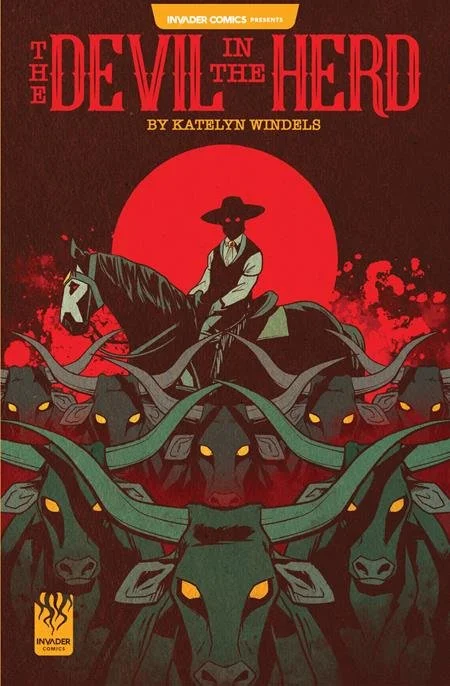
Ty Whitton is back, this time in conversation with New Mexico-based Katelyn Windels - a contributor to the VeeFriends comic series with more projects on the horizon, she makes her solo debut with The Devil in the Herd, a supernatural Western horror one-shot that blew past its Kickstarter goal, distributed through Invader Comics.
COMIC BOOK YETI: Everyone in the Yeti Cave, please welcome Katelyn Windels! Sharp, atmospheric, and deeply unsettling, The Devil in the Herd is a striking first statement from a creator with a lot more to say. How are you doing Katelyn, and what have you been up to lately?
KATELYN WINDELS: I’m doing great! Doing a lot of things lately, promoting the Kickstarter, comic cons, getting the book ready, and my comic day job. Finally cooling down and getting back to just drawing.
CBY: That sounds like an incredibly busy year already! Now, you're both the writer and the artist on this book. As a solo creator, how do you describe The Devil in the Herd when someone asks you what it's about for the first time?
KW: I usually just say it’s a supernatural western horror, but if they give me a little more of their time, I say it’s a story about deep-set dread and a man trying to outrun his sins, but his sins find him.
CBY: The book blends supernatural horror with the Western genre in a really distinct way too. At what stage of developing the story did those two elements — the cattle drive and the guilt-made-manifest Devil — lock together for you?
KW: I think in the first night scene. That’s where I could finally get really creepy with it. We have a cowboy doing a very boring cowboy thing, watching the herd at night, and in the giant mass of horned cattle it was very easy to add in the horror elements. Cows can be very creepy.
CBY: After reading this story, cows are indeed creepy! The Devil's line, "I know what you've done,” is the emotional engine of the whole preview — and then, you hold back what Jed actually did. How do you plan and pace a mystery like this across a single-issue format where you have limited real estate?
KW: I think the main thing is just making promises to the reader that it’ll be revealed eventually, then you have interest in continuing in the story. You wanna know what this character did to warrant all this. As for when the character reveals it, he never actually does. It’s revealed by other means because he’s in denial about the depth of his horrible deed the whole time. He gets pushed to the edge and still doesn’t admit to it, and I think that makes his crime all the more terrible. I really didn’t want people to have pity for him. So really the pacing element was just pushing him more and more until he had nowhere to go.

CBY: The Devil's dialogue is precise and almost courtly — "My dear Jedidiah," — which makes him more unsettling than if he were overtly threatening. How did you develop his voice, and how many drafts did it take to get that tone right?
KW: I knew how I wanted him to speak right away, so almost no drafts were needed there. I think it’s much more fun to show Satan himself as a rather charming gentleman rather than some monstrous beast. He is supposed to lure you into temptation after all. And when The Devil has dialogue, it’s usually with our panicked main character. Having your antagonist be calm and collected while your protagonist is terrified and stammering is a very fun horror element. People speaking politely is always much scarier, to me at least.
CBY: Jed's internal monologue does a lot of heavy lifting in the early pages, giving us his voice before we even see his face clearly. How did you find Jed's narrative voice, and did it change much from your first draft to the final page?
KW: I don’t think his tone changed too much in development. Like the devil, I also knew how I wanted Jed to sound. Having him speak right away without seeing him properly plays into the western genre. Shots of beautiful desert landscape while a nameless voice speaks over it.
Jed’s monologue is so important because this is such a short story, and I also wanted to get to the conflict right away. Jed’s voice does two things. He tells us what’s happening immediately without having to show it over several pages and it also gives the reader a sense for who Jed is as a character. He’s scared, but he can’t say anything. He knows he’s being followed. He’s dreading what this faceless man (the devil) wants. His internal monologue continuously sets up the mood before we lead into the conflict.
CBY: Single panels in the preview without dialogue carry enormous weight — the Bible clutched near sparks and a cross, Jed's expression when he thinks, "I don't think he does." How do you know when to let an image breathe on its own versus supporting it with words?
KW: I think most writers know which lines they most want to sink in with the reader, and comics are awesome because you have an illustration to help show the reader that this is very important or something big is about to happen. You’re painting a picture for them, kind of literally. There’s so many ways to do this and it’s hard to describe in words, but you as the writer know when your climax is coming and you want readers to be excited about that. Versly, you also want your readers to see how the character is feeling without saying much. This is a visual medium after all. The character feels small and alone, draw them very small in a big panel with long looming shadows. The character is shocked, it's time for a close up with bold colors! There’s a million ways to do it and you never really stop learning how to tell a comic story.

CBY: The preview uses two very distinct color palettes — warm pinks and teal for daylight, deep teal and gold at night. Did you develop that color language before or after scripting, and how rigidly did you stick to it?
KW: I developed it before. This was my first comic where I wanted a very distinct color look, and I stuck to it very closely (or at least tried to). There were about five or six drafts of my first page just trying to figure out how I wanted the colors to look. I wanted it to be vibrant and bold, because that’s what the southwest is.
CBY: The color palette choices had me in love with this book artistically! The cattle in this story make a shift from ordinary livestock to something sinister — glowing eyes, demonic silhouettes woven into the herd at night. How do you choreograph that visual transformation across a page without it feeling like a sudden switch?
KW: I did some practice drawings of this, actually. I’d never drawn body horror like this before so I wanted it to be really good. To figure out the actual transformation I drew a regular bull and then my demon design and just kind of tried to figure out what goes in between. Just asking myself questions like “Oh, I suppose the back might start hunching first,” or “it would be really creepy/cool if its jaw broke and reoriented itself.” You know, normal questions.
Before I even had the cows transform into demons, I wanted them to feel unsettling. They all stare at you. They stand completely symmetrically. I was actually inspired when my husband and I went on a hike through a cow pasture. I was raised on a farm, so being around cattle was nothing new for me, but he’d never really been this close to cows before. He kept pointing out how they stared at him or would follow us sometimes, and I was just like “Yeah, that’s just how cows are?”
CBY: Since you're writing and drawing this yourself, how do you keep the writer's vision from automatically winning when the artist in you might tell the story differently on the page?
KW: You know, I don’t really think I have that problem. I know how I want it to look when I’m writing it and I know what I meant when I’m drawing it.

CBY: Mike Perkins is credited as editor. As someone handling the writing and art yourself, what does that editorial relationship actually look like in practice — what does he push back on, and where does his input change the page?
KW: Mike really didn’t want to change too much, honestly. I never got told to do revisions on images, maybe just some spelling errors pointed out. For the most part he just let me do whatever I wanted. So… a really great editor, haha.
CBY: The book ran as a Kickstarter before landing distribution through Invader Comics. Did producing it independently — on your own timeline, for your own backers — shape any creative decisions you wouldn't have made in a more traditional publishing pipeline?
KW: Invader actually picked up my book first and ran the Kickstarter, which I was really happy about because I’d never done a Kickstarter before. I sent my pitch packet to Invader and they got back to me a few days later and said they were interested. They never pushed me much for a deadline or anything, I still made the book in my own time. They were actually surprised I finished when I said I would. I’ve never really published traditionally on my own, so this was all a standard experience to me.
CBY: Looking at the finished preview pages, is there a single panel or page you feel best represents what you were trying to achieve with this book — and why that panel?
KW: I think it’s probably page four; my big Devil reveal page. It’s two panels; one of The Devil and one of Jed. The panel with Satan takes up the top two thirds of the page while Jed is rather small looking at the bottom. The Devil’s overwhelming presence is controlling the page, just like how it controls the story.
CBY: Before we say “So long!” would you be able to share what projects you’re working on now, or will be working on in the future?
KW: One of our stretch goals was another separate story in The Devil in the Herd universe, so you can look forward to more old west Satan! I also have a few more small horror stories I’m slowly developing, now if only I could find time to draw them.
CBY: Where can our followers and team find you on social media these days?
KW: My username is @Katekomics on nearly all socials.
CBY: Katelyn, thank you for taking the time to join us in the Yeti Cave. Getting an inside look at your creative process and the craft behind The Devil in the Herd has been a genuine pleasure — and judging by what's on these pages, readers are in for something truly special!
Like what you've just read? Help us keep the Yeti Cave warm! Comic Book Yeti has a Patreon page for anyone who wants to contribute: https://www.patreon.com/comicbookyeti