


Forest Rivals – Board Game Review

Type of Game: Card Game, Area Control, Spatial Puzzle
Number of Players: 2
Designer: Prof. Ryan Cooke and Steven L. Smith
Artist: Manon Mergnat
Publisher: Button Shy Games
This copy of Forest Rivals was provided as a review copy from the publisher, Button Shy Games.

Forest Rivals is a compact two-player card game from Button Shy Games that pits bears against bees in a battle for control of the forest's honey. With just 18 cards, players must place cards carefully, build groups of animals, and compete to control beehives. It's a small game with a straightforward premise, but the competition over the forest requires players to think about both their own strategy and how to disrupt their opponent's plans.
Concept and Gameplay
At its core, Forest Rivals pits two sides of nature against each other. One player takes control of the bears, while the other commands the bees. The bears want the honey, and the bees aren't particularly interested in giving it up. What follows is a quick contest of card placement, spatial reasoning, and area control.
The game uses a small deck of cards for each player, with both sides taking turns adding cards to a shared play area. Each card features a combination of animal symbols and beehives, and players must decide where and how to place them to build their presence in the forest.
On your turn, you draw a card and choose how to play it. You can place it adjacent to an existing card, provided the symbols line up according to the placement rules, or stack it on top of another card. Stacking lets you cover some of the symbols already in play, allowing you to strengthen your own position while potentially weakening your opponent's.
There are restrictions to consider, however. You can only cover a limited number of symbols when stacking, and beehives can only be covered by other beehives. These rules give the placement decisions some extra weight. A card isn't just an opportunity to add more animals to the forest; it can also be a way to disrupt an opponent's plans or protect an important scoring opportunity.
The objective is to finish the game with more points than your opponent. Scoring comes from two main sources: building the largest connected group of your animals and controlling beehives.
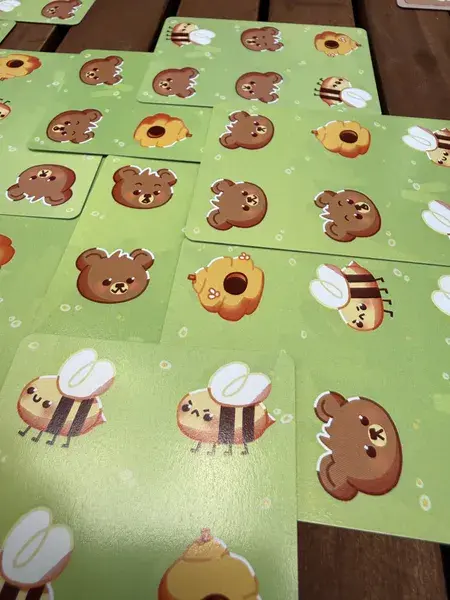
The connected-group scoring rewards players for building up their presence in the forest. Having more animals than your opponent can earn you points, with a larger difference offering a greater reward. However, simply filling the forest with bears or bees isn't enough to guarantee victory.
Beehives provide another way to score. A beehive must be surrounded by animal symbols to count, and the player with the majority of symbols around it earns the point. If both players have equal influence around a beehive, neither receives the point.
This creates an interesting balance between expanding your own animal group and positioning yourself to control the honey. You might have the larger group overall, but if your opponent has managed to surround several beehives, the final score could look very different from what you expected.
With only a limited number of cards available, every placement matters. You need to consider not only what a card accomplishes immediately but also what opportunities it leaves for your opponent. A move that seems beneficial at first might give the other player an easy way to break up your group or take control of a beehive.
Components
One of the defining features of Forest Rivals is its compact format. Button Shy Games specializes in small card games, and Forest Rivals follows that approach with an 18-card design.
The small footprint makes it an appealing option for players who want something they can easily take along to a coffee shop, on a trip, or to game night without having to reserve much table space. There's no large board to assemble or collection of tokens to organize before you can begin playing.

The artwork by Manon Mergnat gives the game a playful woodland identity, with bears and bees competing over the forest's honey. The theme provides a fun contrast to the competitive nature of the gameplay. While the premise is lighthearted, the shared play area becomes a small tactical puzzle as players cover symbols, build groups, and contest beehives.
The minimalist component count also means that the game can get to the table quickly. Once the two decks are ready, players can begin competing almost immediately. For a game designed around a small number of cards, making each placement meaningful is essential, and the combination of animal groups and beehives gives players two objectives to consider throughout the game.
Final Thoughts
Forest Rivals is an interesting take on the two-player card game, combining a charming woodland theme with a competitive battle over territory and resources. The bears-versus-bees premise is easy to understand, but the placement rules give players plenty to consider as they decide whether to expand their own animal groups, cover their opponent's symbols, or focus on controlling beehives.
What stands out about the design is how the two scoring objectives work together. Building the largest connected group can certainly help, but it doesn't necessarily mean you'll win. Players also need to pay attention to the beehives scattered throughout the shared play area, creating a balancing act between building their own presence and preventing their opponent from scoring. That tension is what gives the game its strategic identity.
I also appreciate the compact nature of the design that Button Shy constantly brings to their games. With only 18 cards, Forest Rivals is the sort of game that can fit into a small space in your collection and come along wherever you go. It's easy to imagine pulling it out for a quick game between longer, heavier titles or using it to introduce someone to spatial reasoning and area control without overwhelming them with rules.
For players who enjoy small-box games, tactical card placement, and direct competition, Forest Rivals is worth a look. It takes a simple premise and builds a focused contest around making the most of a limited number of cards. The result is a game where every placement can affect the shape of the forest and the final battle for the honey.
Sometimes, you don't need a sprawling board or a stack of components to create an engaging competition. Sometimes, all you need is a few cards, a forest full of bears and bees, and a fight over who gets to keep the honey.
Late pledges are still available here!
_______________________________________________________________
Like what you've just read? Help us keep the Yeti Cave warm! Comic Book Yeti has a Patreon page for anyone who wants to contribute: patreon.com/CryptidCreatorCornerPod


